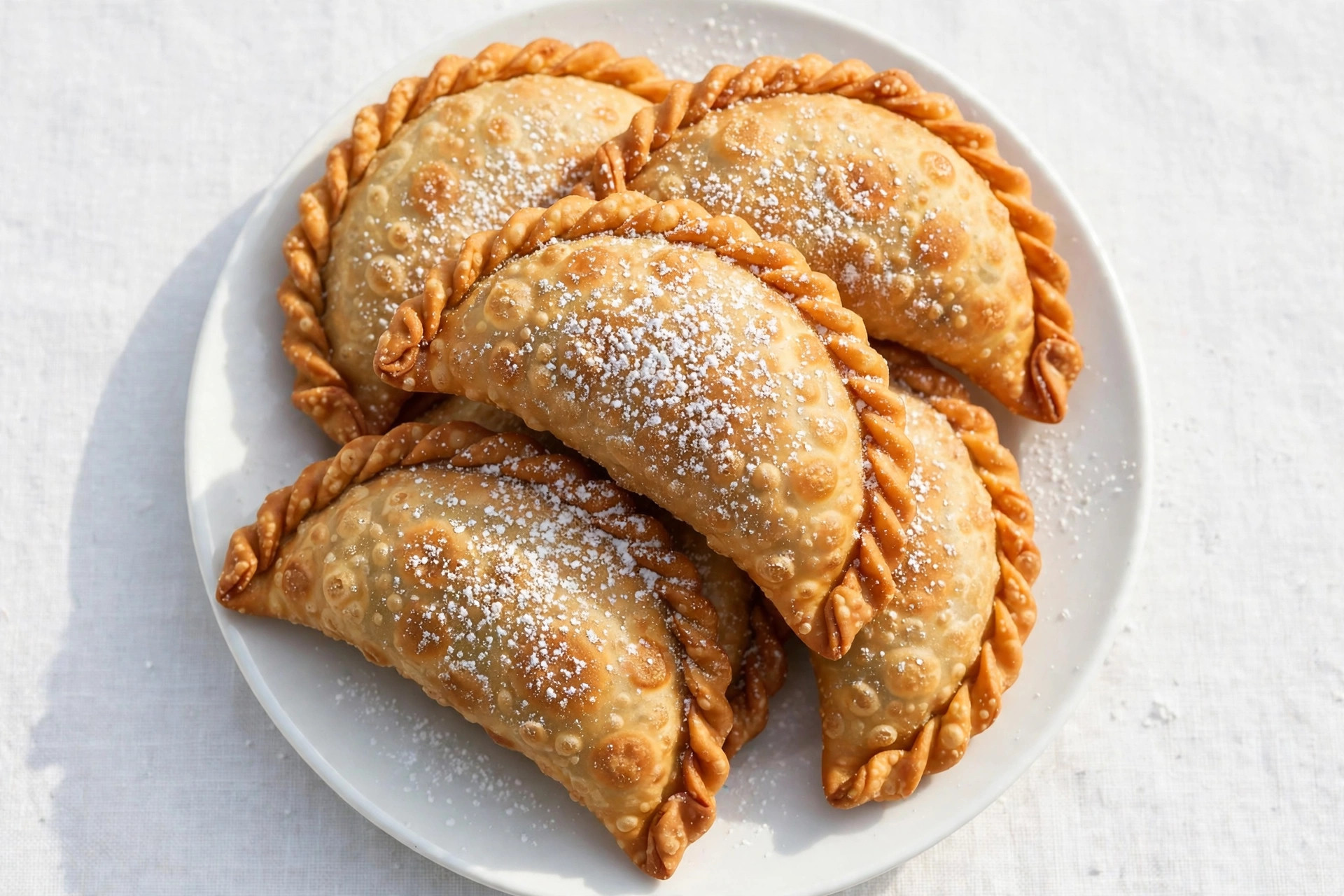
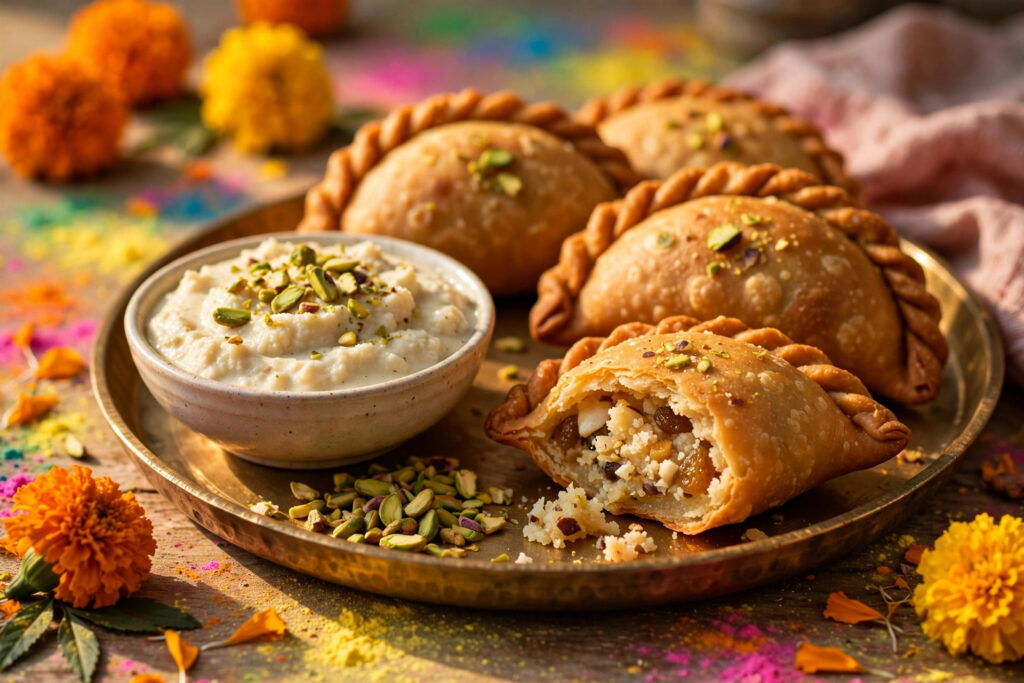
Gujiya is a crisp, half-moon pastry filled with sweetened khoya, coconut and dry fruits, deep-fried in ghee until golden. The shell turns flaky and crisp, while the filling stays soft and fragrant with cardamom. This recipe shows you how to make it at home in about an hour, plus resting time for the dough.
Ingredients
These quantities make about 16 gujiyas and serve 4 people as a dessert. Use fresh khoya for the filling, and keep the dough covered while you work so it stays soft for this sweet.
- 2 cups maida (all-purpose flour)
- 1/4 cup ghee, melted, for the dough
- 1/2 cup water, or as needed
- 1 cup khoya (mawa), crumbled
- 1/2 cup desiccated coconut
- 1/2 cup powdered sugar
- 2 tablespoons almonds, finely chopped
- 2 tablespoons cashew nuts, finely chopped
- 1 tablespoon pistachios, finely chopped
- 1 tablespoon raisins
- 1/2 teaspoon cardamom powder
- 1 tablespoon semolina (sooji), roasted
- Ghee or oil, for deep frying
Step-by-Step Method
Make the dough first. Put the maida in a large bowl and rub in the melted ghee with your fingertips until the mixture looks like breadcrumbs. Add water a little at a time and knead into a firm, smooth dough. Cover it with a damp cloth and rest it for 30 minutes.
Make the filling while the dough rests. Heat a pan on low heat and add the crumbled khoya, stirring often for 4 to 5 minutes until it turns soft and light golden. Take it off the heat and let it cool for 10 minutes, then mix in the coconut, powdered sugar, almonds, cashews, pistachios, raisins, cardamom powder and roasted semolina.
Divide the dough into 16 equal balls and roll each one into a thin circle, about 4 inches across. Keep the rest of the dough covered so it does not dry out. Roll the circles evenly, since a thick edge stays raw while a thin edge can break during frying.
Place 1 tablespoon of filling on one half of a circle, leaving a small border around the edge. Brush the edge with a little water, fold the circle in half, and press the edges together firmly. Crimp the edge with your fingers or a fork so it seals well and the filling stays inside.
Heat ghee in a kadhai on medium-low heat. The ghee should be warm, not smoking hot, so each pastry cooks through slowly. Slide in 4 to 5 gujiyas at a time and fry for 4 to 5 minutes, turning them once, until they turn golden and crisp on both sides.
Lift the fried gujiyas out with a slotted spoon and drain them on paper. Fry the rest the same way, letting the ghee come back to heat between batches. Serve them warm or at room temperature, dusted with a little powdered sugar if you like.
Cooking Time & Servings
Resting the dough takes 30 minutes, and making the filling takes about 15 minutes. Shaping the gujiyas takes about 20 minutes, and frying takes about 25 minutes. The total active time is about 1 hour.
This recipe makes about 16 gujiyas and serves 4 people as a dessert, four pieces each. Serve it warm with a cup of masala chai, or at room temperature as a festive sweet. It is a classic treat for Holi and Diwali.
If you are cooking for two, halve all the ingredients and make 8 gujiyas. For a larger group of eight, double the quantities and fry the gujiyas in small batches so the ghee stays at the right heat.
Practical Tips
Rub the ghee into the maida well before adding water. This step, called moyan, gives it its flaky, crisp shell. The mixture should hold together when you press it in your fist, then crumble when you poke it.
Seal the edges firmly and crimp them well. A loose edge opens in the hot ghee, and the filling leaks out and burns in the oil. Press the edges together with your fingers, then crimp them twice for a tight seal.
Fry it on medium-low heat so the shell cooks through to the centre. High heat browns the outside fast while the inside stays raw and doughy. Slow frying gives a crisp, golden shell that stays crisp for hours.
Common Mistakes
Using a soft dough is the most common mistake. A soft dough absorbs too much ghee and turns oily and soggy. Knead the dough firm, and add water a little at a time so it stays stiff and easy to roll.
Overfilling the pastry is another frequent error. Too much filling strains the edge and makes it burst open in the hot ghee. One tablespoon of filling is enough, with a clear border left around the edge for sealing.
Frying on high heat leaves the shell raw inside. It looks golden on the outside but tastes doughy in the middle. Fry on medium-low heat for the full 4 to 5 minutes, turning once, so it cooks right through.
Variations
For a baked gujiya, brush the sealed pastries with a little melted ghee and bake them in a hot oven at 180°C for 20 to 25 minutes, until golden. Turn them once halfway through so both sides crisp evenly. The baked version uses less ghee and stays light.
For a coconut gujiya, replace the khoya with 1 cup of grated fresh coconut, roasted lightly with sugar and cardamom. The coconut filling turns soft and fragrant, and the sweet tastes fresh and light. Fry it the same way until golden.
For a chocolate gujiya, mix 2 tablespoons of cocoa powder and 2 tablespoons of chocolate chips into the khoya filling. The chocolate melts as it fries and gives a rich centre. Serve it with our besan ladoo for a dessert platter, or try our jalebi for a festive sweet spread.
Storage
It stays crisp at room temperature for up to 3 days. Store the cooled pieces in an airtight container, with a sheet of paper between the layers so they do not stick. Keep the container away from heat and damp.
For longer storage, keep it in the fridge for up to 1 week in an airtight container. Warm it in a hot oven at 180°C for 5 minutes before serving so the shell turns crisp again. Do not freeze the fried pastries, since the shell turns soggy when it thaws.
Frequently Asked Questions
Why does the filling leak while frying?
Leaking usually comes from a loose seal or too much filling. Use only 1 tablespoon of filling, brush the edge with water, and press it firmly before crimping. A tight, double-crimped edge keeps the filling inside the hot ghee.
Can I bake gujiya instead of frying it?
Yes, brush the sealed pastries with melted ghee and bake them at 180°C for 20 to 25 minutes, turning once halfway. The baked shell turns crisp and golden, and the filling stays soft. It uses less ghee than the fried version.
Can I make gujiya ahead of time?
Yes, make the dough and the filling a day ahead and store them separately in the fridge. Shape and fry the gujiyas on the day you serve them, since the fried shell stays crispest when it is fresh from the kadhai.
What should I serve with gujiya?
Gujiya works on its own as a festive sweet, warm or at room temperature. Serve it with our rasmalai and kulfi for a dessert spread. Learn more about the dish on Wikipedia’s gujiya page and see more Indian recipes in the BBC Good Food Indian recipes collection.
For more recipes, visit our About Us page, or try our gulab jamun recipe for another festive dessert.
Leave a Reply