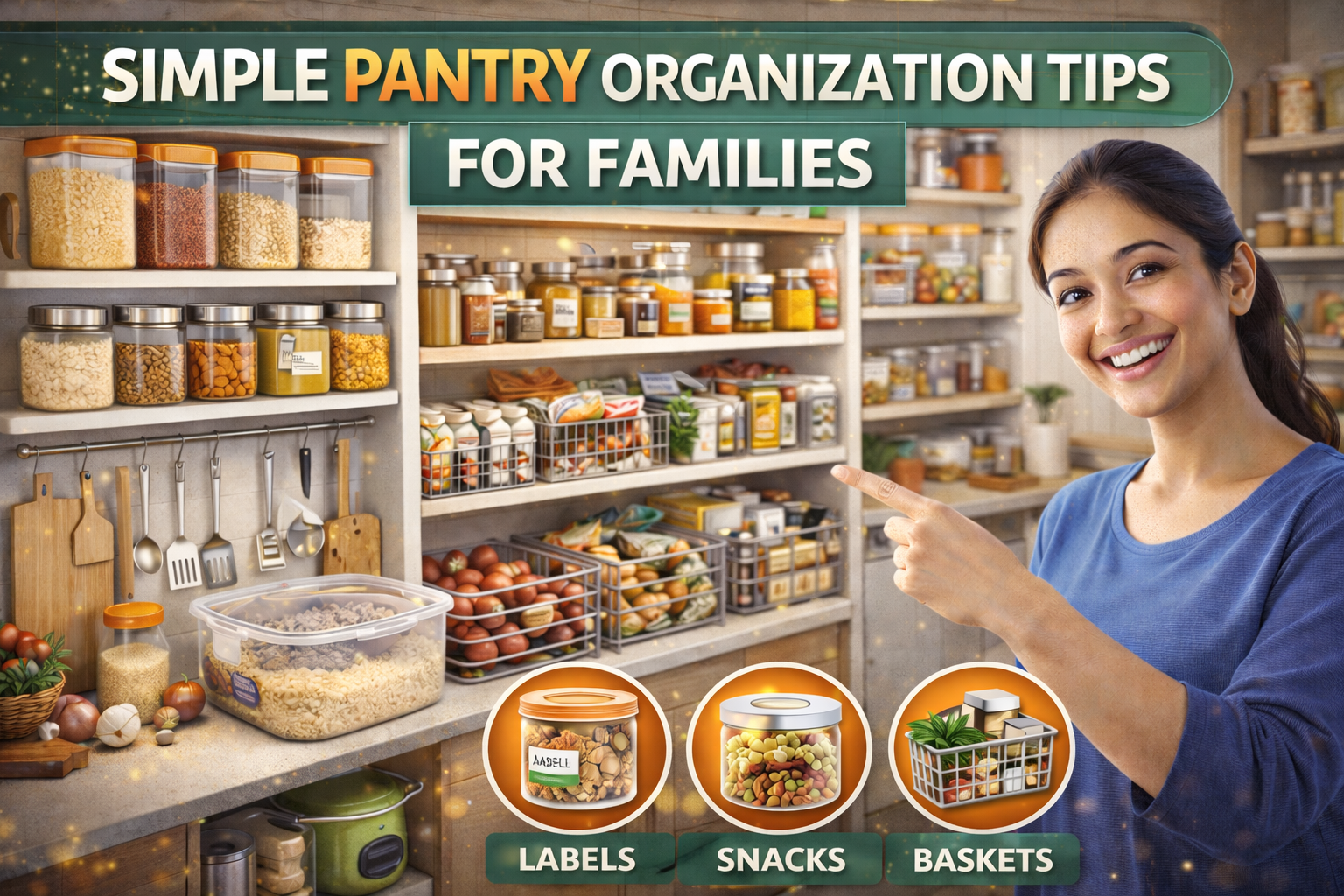
Simple Pantry Organization Tips for Families : The family pantry. It begins with good intentions—a place for food, organized and accessible. But in a busy household, it quickly becomes something else entirely. Cereal boxes topple over. Snack bags multiply mysteriously. Canned goods accumulate at the back, forgotten until their expiration dates have long passed. The pantry that should make feeding your family easier becomes a source of daily frustration.
Organizing a family pantry presents unique challenges. You’re not just organizing for yourself—you’re organizing for multiple people with different needs, different schedules, and different ideas about what “putting things away” means. Children need access to their snacks. Partners need to find ingredients for cooking. Everyone needs to be able to navigate the space without creating chaos.
But a well-organized family pantry is possible. It requires systems that work for everyone, not just the primary organizer. It requires clear labeling, accessible placement, and maintenance habits that the whole family can follow. Most importantly, it requires simplicity—systems so intuitive that even a hungry child can find what they need and put it back correctly.
The ideas that follow are designed specifically for families. They account for multiple users, varying heights, different eating schedules, and the reality of busy household life. From kid-friendly zones to snack stations, from clear labeling to maintenance routines, these tips will transform your family pantry from chaos into calm.
Read More : How to Organize Spices in Small Kitchen
Kitchen Storage Ideas for Indian Homes
How to Store Leftover Food Safely

1. The Family Meeting: Getting Everyone on Board
Before you touch a single item, before you buy any organizing products, gather your family for a conversation. The success of your pantry organization depends on everyone understanding and buying into the system .
Explain why you’re organizing the pantry. Frame it positively—not as a chore, but as a way to make everyone’s life easier. “We’re going to organize the pantry so everyone can find their favorite snacks. You’ll be able to see what we have, and we won’t keep buying things we don’t need.”
Ask for input. What do family members want from the pantry? Where do they struggle to find things? What snacks should be easily accessible? Involving everyone in the planning creates ownership and increases the likelihood that they’ll maintain the system .
Assign age-appropriate roles. Younger children can help sort items by category. Older children can handle checking expiration dates. Teenagers can help with heavy lifting. When everyone contributes, everyone feels invested .
Set expectations together. Discuss how the family will maintain the new system. “When you finish a snack, put the package back in its spot. If you finish something, add it to the shopping list.” Clear expectations prevent confusion .
2. The Great Family Purge: Empty and Assess
With everyone on board, it’s time for the great purge. Empty your pantry completely. Every item, from every shelf, must come out. This is the only way to truly see what you have .
As you remove items, have family members sort them by category on your kitchen table or counters. All canned vegetables together. All pasta together. All snacks together. All breakfast items together. This preliminary grouping reveals the full scope of your possessions and makes the next steps easier .
Now comes the decision-making. Have family members help check expiration dates. This is a great task for older children—they learn about food safety while contributing. Anything past its expiration goes in the trash .
For items still in date, evaluate whether anyone will actually eat them. That box of crackers no one likes? That weird condiment bought for one recipe? If no one in the family will consume it, donate unopened items to a food bank .
Be honest about duplicates. How many boxes of cereal are open? How many bags of pretzels? Consolidate where possible and designate a “finish these first” zone for items that need to be used up .
3. Categorization: Creating Logical Groups
With everything sorted and purged, you need to create categories that make sense for your family. The goal is to group similar items together so everyone knows where to look .
Common family pantry categories include:
- Breakfast: cereal, oatmeal, pancake mix, syrup
- Snacks: granola bars, crackers, cookies, fruit snacks, nuts
- Lunch: bread, peanut butter, jelly, lunch kits
- Baking: flour, sugar, chocolate chips, baking soda
- Grains: rice, pasta, quinoa, couscous
- Canned goods: vegetables, fruits, beans, soups, tomatoes
- Sauces and condiments: pasta sauce, ketchup, mustard, salad dressing
- Beverages: coffee, tea, hot chocolate, drink mixes
- Kids’ zone: items children can access independently
- “Use soon” zone: items that need to be eaten before they expire
Within each category, you may want subcategories. For snacks, for example, group granola bars together, fruit snacks together, crackers together. This level of detail makes finding specific items even easier .
Consider your family’s eating habits. If you have children who pack lunches, create a lunch-packing zone with everything they need in one place. If you have a family member with dietary restrictions, create a dedicated zone for their special items .
4. Kid-Friendly Zones: Empowering Independence
One of the most important aspects of family pantry organization is creating zones that children can access independently. This empowers them to get their own snacks and builds lifelong organizational habits .
Designate lower shelves or bins for kid-friendly items. Place these at a height your children can reach without help. This might be the bottom shelf of the pantry or a low cabinet nearby .
Use clear bins for kid snacks so children can see what’s available without digging. Label bins with words and pictures—younger children who can’t read yet can still identify their snacks by the picture .
Keep frequently used items at the front. If your children eat granola bars daily, place them where little hands can grab easily. Less frequently used snacks can go behind .
Establish rules for the kid zone. “You can take one snack at a time. When you finish a box, tell a grown-up so we can add it to the shopping list.” Clear expectations prevent over-consumption and waste .
Involve children in maintaining their zone. Show them where things belong and expect them to return empty packages or containers. This teaches responsibility while keeping your pantry organized .
5. Clear Labeling: Everyone Can Read
Labels are essential for family pantries. They tell everyone where things belong and make it easy to return items correctly. Without labels, even the best-organized pantry will quickly descend into chaos .
Use large, clear labels that everyone can read. Consider using pictures alongside words for younger children or family members who speak different languages. A picture of a granola bar next to the word helps non-readers participate .
Label shelves to indicate what belongs in each zone. “Breakfast,” “Snacks,” “Canned Vegetables”—these shelf labels guide users and make restocking intuitive .
Label bins and baskets clearly. If you use clear bins, a simple label on the front works. For opaque bins, labeling is essential .
Consider color-coding for different family members. Each person could have a designated color for their special snacks or lunch items. This makes it easy to see at a glance what belongs to whom .
Refresh labels when they become worn or when categories change. Clean, legible labels make maintenance easier for everyone .
6. Bins and Baskets: Containing the Chaos
Bins and baskets are essential for family pantry organization. They corral similar items, prevent small packages from getting lost, and create visual order .
Choose bins that are sturdy enough for daily use by multiple family members. Clear bins allow everyone to see contents at a glance, which is particularly helpful for children who can’t read labels yet .
Use bins of varying sizes based on what they’ll hold. Large bins for snacks, medium bins for lunch items, small bins for packets and single-serve items. Bins that are too large encourage overfilling; bins that are too small create spillover .
Label each bin clearly. When bins are labeled, everyone knows where things belong. This simple step makes it much more likely that items will be returned to their proper places .
Consider using open bins for frequently used items. These are easier for children to access than bins with lids. Reserve lidded bins for items that need extra protection or that you want to limit access to .
7. The First-In, First-Out System: Reducing Waste
In busy families, food waste is a constant concern. Items get pushed to the back, forgotten, and eventually expire. A first-in, first-out (FIFO) system prevents this waste .
When you add new items to the pantry, place them behind existing ones. This ensures that older items get used before they expire. Teach this principle to everyone in the family .
For items that are close to expiring, create a “use soon” zone. This could be a small bin or a designated shelf where these items live until someone uses them. Check this zone weekly and incorporate items into meal planning .
When unpacking groceries, make FIFO a family activity. Have children help put away new items, teaching them to check dates and place new items behind old ones. This builds awareness and responsibility .
Regularly check expiration dates as a family activity. A monthly “pantry audit” where everyone helps check dates keeps the system working and teaches children about food safety .
8. The Shopping List Connection
An organized pantry connects directly to smarter shopping. When you can see what you have, you buy less duplicate items and waste less food .
Keep a shopping list in a visible location—on the refrigerator, on a bulletin board, or in a family communication app. When someone finishes an item, they add it to the list immediately .
Teach family members to check the pantry before adding to the list. “We might be out of granola bars, but let’s check the bin first.” This prevents unnecessary purchases .
When planning meals, check the pantry first. Build meals around what you already have, particularly items in the “use soon” zone. This reduces waste and saves money .
After shopping, involve family members in putting away groceries. This reinforces where things belong and gives everyone ownership of the system .
9. Visible Storage: Seeing Is Remembering
In a family pantry, visibility is crucial. When items are hidden, they’re forgotten. When they’re visible, they get used .
Use clear containers for dry goods whenever possible. Flour, sugar, cereal, pasta—when you can see what’s inside, you’re more likely to use it and less likely to buy duplicates .
For items in opaque bins, label clearly and consider using open-front bins that show contents. If you must use solid bins, make them shallow so items don’t get lost at the back .
Arrange items so that everything is visible at a glance. Avoid stacking items so high that they block the view of what’s behind. Use risers to create stadium-style visibility .
For families with children, consider using a small step stool so little ones can see higher shelves. This empowers them to participate in choosing snacks and helps them learn the system .
10. The Weekly Reset: Family Maintenance
Even with the best systems, family pantries need regular maintenance. The weekly reset is a simple habit that prevents chaos from accumulating .
Choose a consistent time each week for a pantry check. Sunday afternoon, before grocery shopping, works well for many families. Make it a 10-minute family activity .
During the weekly reset, straighten bins, return stray items to their homes, and check for anything that needs to be added to the shopping list. This quick tidying prevents small problems from becoming big ones .
Involve children in the weekly reset. Assign age-appropriate tasks—younger children can straighten the snack zone, older children can check expiration dates. Make it routine, not optional .
The weekly reset is also a chance to notice what’s working and what isn’t. If a particular zone is consistently messy, the system may need adjustment. Pay attention and adapt .
11. Seasonal Deep Cleans: Refreshing the System
Beyond weekly maintenance, family pantries benefit from seasonal deep cleans. Four times a year—perhaps at the change of seasons—do a thorough pantry reset .
During the seasonal deep clean, remove everything from the pantry. Wipe down all shelves thoroughly. Check every expiration date. Reevaluate your categories and bins .
This is also a good time to involve children in a more substantial way. Older children can help with deep cleaning. Younger children can help sort and categorize .
Use seasonal deep cleans to refresh your system. Maybe the snack zone needs to be larger now that children are older. Maybe new categories have emerged. Adjust your system to meet your family’s evolving needs .
Seasonal deep cleans also provide an opportunity to involve children in charitable giving. Set aside items that are still good but that your family won’t use, and have children help deliver them to a food bank .
12. Flexibility: Adapting as Your Family Grows
The best family pantry systems are flexible. As your children grow, as your eating habits change, as your family’s needs evolve, your pantry should evolve with you .
When children are young, lower shelves for kid-friendly snacks make sense. As they grow, their zone can expand upward. Teenagers may need a different kind of snack zone than elementary children .
As family members develop dietary restrictions or preferences, create dedicated zones for their special items. A gluten-free zone, a dairy-free zone—these help everyone find what they need .
As your cooking habits change, adjust your categories. If you start baking more, expand your baking zone. If you’re trying to eat more whole foods, make grains and legumes more accessible .
Regularly ask family members for feedback. What’s working? What’s frustrating? What would make the pantry work better for them? Involving everyone in ongoing improvement keeps the system relevant .
| Organization Tip | Purpose | Family Involvement | Time Required |
|---|---|---|---|
| Family Meeting | Get everyone on board | All members | 30 minutes |
| The Great Purge | Remove what you don’t need | Age-appropriate sorting tasks | 2-3 hours |
| Categorization | Create logical groups | Input on categories | 1 hour |
| Kid-Friendly Zones | Empower independence | Children choose snack placement | 30 minutes |
| Clear Labeling | Everyone can read | Children can help with pictures | 1 hour |
| Bins and Baskets | Contain the chaos | Children help sort into bins | 1 hour |
| FIFO System | Reduce waste | Teach children to check dates | Ongoing |
| Shopping List Connection | Smart shopping | Everyone adds to list | Ongoing |
| Visible Storage | See what you have | Children help with arrangement | 30 minutes |
| Weekly Reset | Maintain order | 10 minutes weekly as family | 10 minutes/week |
| Seasonal Deep Cleans | Refresh the system | All members contribute | 2-3 hours quarterly |
| Flexibility | Adapt as family grows | Ongoing feedback | Ongoing |
The Emotional Benefits of Family Pantry Organization
An organized family pantry provides benefits beyond the practical. It reduces stress for everyone—no more frantic searching for snacks before school, no more frustration when ingredients can’t be found. It teaches children valuable life skills—organization, responsibility, and food awareness .
When children can access their own snacks, they develop independence. When they help maintain the pantry, they learn that household systems require everyone’s participation. When they see food organized rather than chaotic, they internalize that order is possible .
An organized pantry also models mindful consumption. Children see what the family has, learn to check before buying, and understand that food is a resource to be managed, not wasted .
For parents, an organized pantry reduces mental load. You don’t have to remember everything—the system remembers for you. You can see at a glance what you have and what you need. Meal planning becomes easier, shopping becomes more efficient, and cooking becomes more enjoyable .
Conclusion : Simple Pantry Organization Tips for Families
A well-organized family pantry is possible. It requires systems that work for everyone, clear communication, and regular maintenance. But the payoff is enormous—less stress, less waste, more independence for children, and a kitchen that actually supports your family’s life .
Start with a family meeting. Get everyone on board and gather input. Empty the pantry together and purge ruthlessly. Create categories that make sense for your family. Establish kid-friendly zones that empower children. Label everything clearly. Use bins to contain chaos. Implement FIFO to reduce waste. Connect the pantry to your shopping list. Make items visible. Establish weekly maintenance. Do seasonal deep cleans. And remain flexible as your family grows .
The result is not just an organized pantry but a transformed relationship with food and with each other. When everyone can find what they need, when systems support rather than frustrate, when children learn to participate—that’s when a family pantry truly succeeds .
Your family’s pantry awaits. With these simple tips, you can create order that works for everyone. Start today. Your future self—and your family—will thank you .
1 thought on “Simple Pantry Organization Tips for Families”