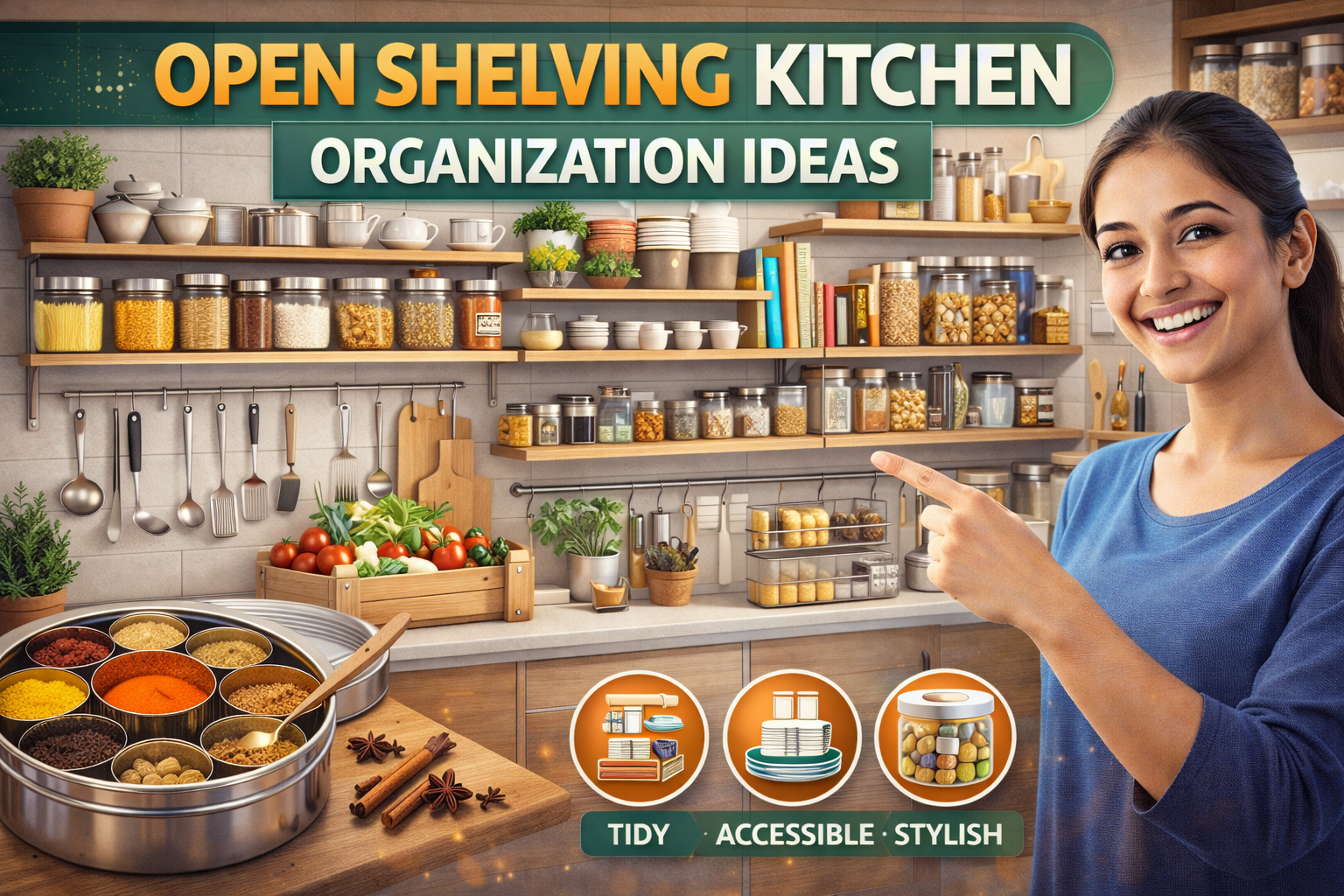
Open Shelving Kitchen Organization Ideas : Open shelving has taken the kitchen world by storm, and for good reason. It transforms the heart of the home from a space of hidden clutter into one of curated beauty. Dishes become decor. Glassware catches light. Cookbooks add color and personality. The kitchen becomes not just functional but expressive—a reflection of who lives there and what they love.
But open shelving also presents challenges. Unlike closed cabinets, which hide our organizational sins behind doors, open shelves display everything. There’s no place to shove clutter, no door to close on chaos. Every item is visible, every arrangement matters. This visibility can be intimidating, but it’s also liberating. It forces intentionality, curation, and thoughtful design.
The ideas that follow cover every aspect of open shelving organization, from choosing what to display to creating visually pleasing arrangements. They address practical concerns like dust and accessibility while embracing the aesthetic possibilities that open shelving offers. Whether you’re installing new shelves or reorganizing existing ones, these ideas will help you create a kitchen that’s both beautiful and functional.
Read More : How to Keep Vegetables Fresh for Longer in Fridge
How to Clean Burnt Utensils Without Chemicals
How to Maintain Wooden Kitchen Cabinets Properly
How to Remove Oil Stains from Kitchen Tiles Easily

1. The Philosophy of Open Shelving: Why It Works
Before diving into specific techniques, it’s worth understanding why open shelving has become so popular and how it differs from traditional cabinet storage .
Open shelving creates visual lightness. Closed upper cabinets can feel heavy and imposing, particularly in small kitchens. Open shelves, by contrast, allow the eye to travel through the space, making rooms feel larger and more open .
Open shelving forces curation. You can’t hide clutter on open shelves, so you must be intentional about what you keep. This leads to a more edited, thoughtful collection of items—only what you truly need and love .
Open shelving makes items accessible. No more opening doors to find what you need. Dishes, glasses, and frequently used ingredients are right there, visible and reachable. This accessibility can make cooking and daily tasks easier .
Open shelving adds personality. Your dishes, your glassware, your cookbooks—these become part of your kitchen’s design. They express your style, your interests, your history. A kitchen with open shelving feels more personal, more lived-in .
2. The Great Edit: Choosing What to Display
The first step in open shelving organization is editing your possessions ruthlessly. Not everything deserves to be on display .
Start by removing everything from your current shelves. Yes, everything. You need to see the full scope of what you have .
Now evaluate each item with brutal honesty. Does it earn a place on display? Criteria include:
- Beauty: Is this item visually appealing? Does it contribute to the overall look?
- Function: Do you use this regularly? Does it serve a purpose in your daily life?
- Condition: Is it in good shape? Chipped, cracked, or worn items don’t belong on display
- Sentiment: Does this item have meaning? A piece from a loved one might earn a place even if less beautiful
Be ruthless about duplicates. How many matching white plates do you really need? Keep a reasonable quantity for your household and store the rest elsewhere or donate them .
For items that don’t make the cut, you have options. Store them in lower cabinets if you need them occasionally. Donate them if you don’t. But don’t put them back on open shelves just because you have them .
3. The Rule of Thirds: Creating Visual Balance
Once you’ve edited your collection, the next challenge is arranging items on your shelves. The rule of thirds provides a useful framework for creating visually pleasing arrangements .
Divide each shelf mentally into three sections. Fill about two-thirds of the space with items, leaving one-third empty. This empty space provides breathing room, preventing shelves from looking cluttered or overwhelming .
Within those sections, vary the heights of items. Group tall items together, medium items together, short items together. This creates visual rhythm and prevents a monotonous line of similar-height items .
Create focal points where your eye rests. A beautiful pitcher, a collection of white plates, a stack of colorful cookbooks—these focal points draw the eye and anchor the arrangement .
Step back and assess. Does the arrangement feel balanced? Is there visual variety? Is there enough empty space? Adjust until it feels right .
4. Grouping Strategies: Creating Cohesive Collections
How you group items on open shelves dramatically affects the overall look. Thoughtful grouping creates cohesion; random placement creates chaos .
Group by color for maximum impact. All white dishes together create a clean, minimalist look. A collection of blue-and-white ceramics makes a striking statement. Color grouping turns everyday items into design elements .
Group by type for practical clarity. All dinner plates together, all bowls together, all glasses together. This makes finding what you need intuitive and creates visual order .
Group by material for textural interest. Wood cutting boards together, ceramic bowls together, glassware together. The repetition of material creates rhythm while allowing variation in shape and size .
Group by frequency of use for accessibility. Everyday dishes on lower, easily reachable shelves. Occasional pieces on higher shelves. This practical consideration ensures your arrangement works for daily life .
5. Styling with Layers: Depth and Dimension
Open shelves have depth, and using that depth effectively creates more interesting arrangements. Layering items front to back adds dimension .
Place larger items toward the back. A large platter leaning against the wall, taller canisters behind smaller ones—this creates a sense of depth and prevents shelves from looking flat .
Place smaller items toward the front. Spice jars, small bowls, everyday glasses—these belong where they’re easily reachable and visible .
Lean items for visual interest. A large cutting board, a beautiful platter, a cookbook—leaning these against the back wall adds variety and breaks up the line of upright items .
Use risers or small stands to elevate items at the back. This ensures they’re visible even with items in front. A small cake stand, for example, can elevate a bowl or canister .
6. The Power of Symmetry and Asymmetry
Both symmetrical and asymmetrical arrangements can work beautifully on open shelves. Understanding when to use each helps you achieve your desired look .
Symmetrical arrangements create calm and formality. Matching items on either side of a central focal point feel balanced and intentional. This works well for modern or traditional kitchens where order is valued .
Asymmetrical arrangements create energy and interest. Different items balanced by visual weight rather than exact matching feel more dynamic and collected. This works well for eclectic or rustic kitchens where personality is paramount .
You can mix approaches across shelves. One shelf might be symmetrical, another asymmetrical. The key is intentionality—each arrangement should feel deliberate, not accidental .
Consider the items you have. If you have many matching pieces, symmetrical arrangements may come naturally. If your collection is more eclectic, asymmetrical arrangements may work better .
7. Incorporating Greenery and Decor
Open shelves aren’t just for functional items. Greenery and decorative pieces add life, color, and personality to your displays .
Small potted herbs bring freshness and utility. Place them near the kitchen where you’ll use them in cooking. Choose herbs that thrive indoors—basil, mint, rosemary .
Trailing plants add softness and movement. A small pothos or philodendron cascading over the edge of a shelf softens hard lines and adds organic texture .
Artful objects punctuate your arrangement. A small ceramic piece, a beautiful vase, a meaningful object—these add personality and create focal points .
Seasonal touches keep your kitchen feeling fresh. A small pumpkin in fall, pine sprigs in winter, fresh flowers in spring—rotating seasonal elements prevents your shelves from feeling static .
The key with decor is restraint. A few carefully chosen pieces enhance an arrangement; too many create clutter. Let your functional items be the stars, with decor as accent .
8. Baskets and Bins: Containing the Chaos
Even on open shelves, some items benefit from containment. Baskets and bins corral small items while maintaining the open, airy feel .
Use baskets for items that don’t look beautiful individually. Snack packages, tea bags, root vegetables—these practical items can be grouped in attractive baskets that hide their utilitarian nature .
Choose baskets that complement your kitchen’s style. Woven baskets add warmth and texture. Wire baskets have an industrial edge. Ceramic canisters offer a clean, uniform look .
Label baskets clearly. When everyone knows what’s inside, finding items is easy and returning them is more likely. Labels also add a decorative element .
Group similar items in each basket. One basket for tea, one for coffee supplies, one for snacks. This makes the system intuitive and maintains order .
9. Cookbook Storage: Function and Beauty
Cookbooks are natural candidates for open shelving. They add color, texture, and personality while keeping your recipes accessible .
Arrange cookbooks both vertically and horizontally. Vertical stacks are practical for frequently used books. Horizontal stacks create visual variety and can elevate other items .
Face some books forward. A beautiful cover becomes art when displayed facing out. Rotate which books face forward to keep the display fresh .
Group by color for a cohesive look if you have many books. The repetition of color creates a striking visual statement. Or group by cuisine or size—whatever creates order .
Leave room for new additions. Cookbook collections tend to grow. Leave some space on your shelves for future acquisitions .
10. Practical Considerations: Dust and Maintenance
Open shelves do require more maintenance than closed cabinets. Dust settles on everything, and items need regular attention .
Accept that you’ll need to dust more frequently. A quick weekly dusting keeps shelves looking fresh. Use a microfiber cloth or a duster with an extendable handle for easy reach .
Rotate items when you clean. Move dishes, wipe shelves, and return items. This prevents dust from accumulating underneath and gives you a chance to reassess your arrangement .
Wash displayed items periodically. Dishes and glassware that sit out collect dust and need occasional washing. A quick wash before using keeps them fresh .
Consider your cooking habits. If you fry foods often, grease can settle on open shelves. A good range hood helps, but you may need to clean more frequently .
The extra maintenance is the trade-off for beauty. For many, it’s worth it. But be realistic about whether you’re willing to commit to the upkeep .
11. Child-Friendly Open Shelving
If you have children, open shelving requires additional consideration. Little hands reach for everything, and safety is paramount .
Place heavy or fragile items on higher shelves. Your beautiful ceramic platter belongs where little hands can’t reach it. Everyday dishes children use belong lower .
Designate a lower shelf for child-accessible items. Their cups, plates, and bowls can live here, empowering them to get their own things while keeping them out of more dangerous areas .
Use non-slip shelf liners on shelves children access. This prevents items from sliding when little hands grab them .
Consider the weight of items on lower shelves. Heavy items should be stored lower for safety, but ensure the shelf and brackets are rated for the load .
Teach children how to access items safely. Show them which shelves are theirs and how to reach items without pulling everything down .
12. Adapting as Your Kitchen Evolves
The beauty of open shelving is its flexibility. Unlike built-in cabinets, open shelves can be easily reconfigured as your needs and tastes change .
Reassess your arrangement periodically. Every few months, step back and look at your shelves with fresh eyes. Does the arrangement still work? Does it still feel fresh ?
Rotate items seasonally. Bring out different dishes for different seasons. Store summer pieces during winter and vice versa. This keeps your kitchen feeling current .
Adjust as your collection changes. New dishes, new cookbooks, new decorative pieces—integrate them thoughtfully, removing something else to maintain balance .
Don’t be afraid to change things up. If an arrangement isn’t working, try something different. Open shelving invites experimentation .
| Organization Idea | Purpose | Key Considerations | Best For |
|---|---|---|---|
| The Great Edit | Choose what to display | Beauty, function, condition | All kitchens |
| Rule of Thirds | Create visual balance | Empty space, height variation | All arrangements |
| Grouping Strategies | Create cohesion | Color, type, material, frequency | All kitchens |
| Layering | Add depth | Front-to-back arrangement | Deeper shelves |
| Symmetry/Asymmetry | Set the mood | Intentional balance | Depends on style |
| Greenery and Decor | Add life | Restraint, seasonal rotation | All kitchens |
| Baskets and Bins | Contain small items | Style, labeling | Practical storage |
| Cookbook Storage | Function and beauty | Vertical/horizontal mix | Cookbook lovers |
| Dust Management | Practical maintenance | Weekly dusting, occasional washing | All open shelves |
| Child-Friendly | Safety and access | Height placement, non-slip | Families with children |
| Adaptability | Evolve with you | Seasonal rotation, reassessment | All kitchens |
The Psychology of Open Shelving
Open shelving changes not just how your kitchen looks but how you interact with it. When your beautiful dishes are on display, you’re more likely to use them. When your cookbooks are visible, you’re more likely to cook from them. When your kitchen reflects your personality, you’re more likely to enjoy being in it .
There’s also a psychological shift in how you relate to your possessions. Open shelving forces you to curate, to keep only what you truly need and love. This intentionality often extends beyond the kitchen, influencing how you think about possessions throughout your home .
The visibility of open shelving can also reduce stress. No more opening cabinet doors to search for what you need. Everything is visible, everything is accessible. This ease of use makes daily tasks smoother and more pleasant .
Common Mistakes to Avoid
As you embrace open shelving, watch out for common pitfalls that can undermine your efforts .
Overcrowding is the most common mistake. Resist the urge to fill every inch. Empty space is essential for visual calm .
Ignoring functionality is another. Beautiful arrangements that don’t work for daily use will frustrate you. Keep everyday items accessible .
Neglecting maintenance leads to dust and grime. Commit to regular cleaning or open shelving may not be for you .
Mixing too many styles creates visual chaos. Aim for cohesion—not everything needs to match, but there should be a unifying thread .
Conclusion : Open Shelving Kitchen Organization Ideas
Open shelving offers a beautiful way to organize your kitchen, turning everyday items into design elements and making your space feel larger, lighter, and more personal. The ideas in this guide—from editing ruthlessly to creating balanced arrangements, from incorporating greenery to managing dust—provide a roadmap for success .
Start with the great edit. Remove everything and evaluate what truly deserves display. Group thoughtfully, considering color, type, and frequency of use. Layer items front to back for depth. Incorporate greenery and meaningful decor. Use baskets to contain the practical. Maintain regularly and adapt as your needs change .
The result is a kitchen that’s not just organized but expressive—a space that reflects who you are and what you love. Your dishes become art. Your cookbooks become color. Your kitchen becomes you .
Open shelving awaits. With these ideas, you can create a kitchen that’s beautiful, functional, and truly yours .