
Kitchen Storage Ideas for Indian Homes : The Indian kitchen is a world unto itself. It’s a place of vibrant flavors, aromatic spices, and cooking traditions that span millennia. It’s also a space with unique storage challenges that standard Western organizing advice simply doesn’t address. Where do you store fifteen different spices? How do you manage the endless variety of dals and lentils? What about the specialized cookware—kadhai, tawa, sil batta—that doesn’t fit in standard cabinets?
Indian cooking requires a diverse array of ingredients and tools. A typical Indian kitchen might stock twenty or more whole and ground spices, multiple types of lentils, several varieties of rice, and specialized equipment for grinding, rolling, and frying. Add to this the daily essentials—ghee, oil, atta for chapatis—and you have a storage puzzle that demands creative solutions.
The ideas that follow are designed specifically for Indian kitchens. They address the unique needs of Indian cooking while respecting the space constraints of modern homes. From masala dabba organization to dal storage, from kadhai placement to pantry solutions, these ideas will help you create a kitchen that honors tradition while embracing efficiency.
Read more: How to Deep Clean Kitchen Sink Step by Step
How to Organize Spices in Small Kitchen
How to Get Rid of Kitchen Odor Naturally
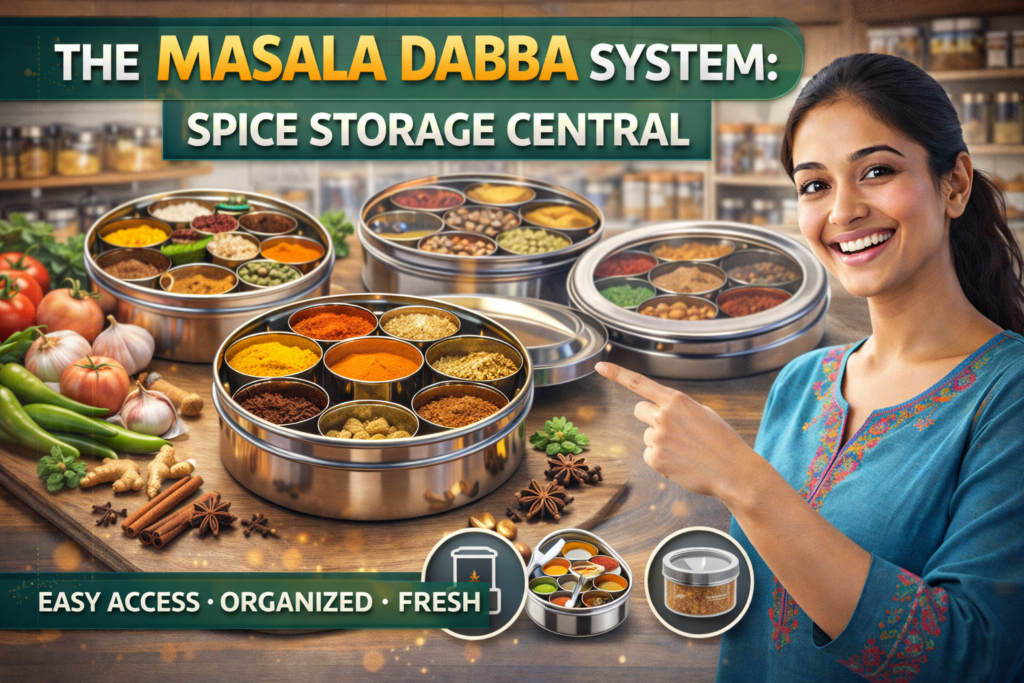
1. The Masala Dabba System: Spice Storage Central
The masala dabba—that iconic round stainless steel box with its array of small cups—is the heart of Indian spice organization. But even this classic solution can be optimized for modern kitchens .
Start with a quality masala dabba. Stainless steel is traditional and practical—it doesn’t absorb odors, it’s easy to clean, and it looks beautiful. Choose a size that fits your cooking habits. A seven-cup dabba works for most households; larger families may need nine or more cups .
Stock your dabba with your most-used spices. These typically include turmeric, red chili powder, cumin seeds, mustard seeds, coriander powder, and garam masala. The exact selection depends on your cooking style. Keep these everyday spices in the dabba for easy access while cooking .
Label the lid of each cup. When you’re cooking, you don’t want to guess which spice is which. A small sticker on the lid or a permanent marker identification saves time and prevents mistakes .
Store your masala dabba where you can reach it easily while cooking. Near the stove is ideal. Keep it on the counter or in a pull-out drawer beside your cooking zone .
For spices you use less frequently—whole spices, specialty blends, seasonal ingredients—store them separately. Small glass jars in a dedicated cabinet or drawer keep them organized and visible .
2. Dal and Lentil Storage: Clear Visibility
Indian kitchens typically stock multiple types of dals and lentils—toor dal, moong dal, chana dal, urad dal, masoor dal, and more. Keeping them organized and visible prevents duplicate purchases and ensures you use what you have .
Clear glass or plastic containers are essential for dal storage. When you can see what’s inside, you know at a glance what you have and how much is left. Square containers pack more efficiently than round ones, saving shelf space .
Label each container clearly. Include the name in English and Hindi if that helps your household. Consider adding a small picture for family members who may not read the language .
Store dals together in a dedicated zone. This might be a cabinet shelf, a pull-out drawer, or a section of your pantry. Keeping them together makes inventory easy and cooking efficient .
Consider portion sizes when choosing containers. If you buy dal in bulk, store the main supply in a large container and keep a smaller, daily-use container accessible. This reduces how often you need to access the bulk storage .
3. Atta and Flour Storage: Keeping It Fresh
Atta (whole wheat flour) is a staple in most Indian homes, used daily for chapatis and rotis. Proper storage keeps it fresh and prevents pests .
A large, airtight container is essential for atta. Choose one with a tight-sealing lid to keep moisture out and freshness in. Stainless steel or food-grade plastic both work well .
Consider a container with a wide mouth for easy scooping. You’ll access your atta daily, so convenience matters. Some containers come with scoops or measuring cups attached .
Store atta in a cool, dry place away from direct sunlight. A lower cabinet or pantry shelf works well. Avoid storing near the stove or other heat sources .
For other flours—besan, rice flour, ragi—use smaller, clear containers. Label them clearly and store near your atta. Group all flours together for easy access .
4. Kadhai and Tawa Storage: Managing Bulky Cookware
Indian kitchens use specialized cookware that doesn’t stack neatly. Kadhai (wok-like pans), tawa (flat griddles), and pressure cookers require thoughtful storage solutions .
For kadhai, consider vertical storage. A narrow cabinet with dividers can hold multiple kadhai on their sides, making them accessible without stacking. If you don’t have a dedicated cabinet, a pot rack mounted on the wall or ceiling works beautifully .
For tawa, flat storage is ideal. A shallow drawer with dividers can hold tawa flat, protecting their surface. If drawer space is limited, store tawa vertically in a divided cabinet alongside baking sheets .
Pressure cookers are bulky and heavy. Store them in lower cabinets where they’re easy to access without lifting overhead. If you have multiple cookers, consider nesting them with protectors between to prevent scratching .
For smaller specialized tools—sil batta (grinding stone), chakla belan (rolling board and pin)—find dedicated homes. A deep drawer or lower cabinet works well. Keep them together since they’re used together .
5. The Indian Pantry: Zones for Efficiency
A well-organized Indian pantry has distinct zones for different categories of items. Creating these zones makes cooking easier and inventory simpler .
Create a spice zone for all your spices. This includes your everyday masala dabba plus backup jars of whole and ground spices. Use tiered organizers to see everything at a glance. Group similar spices together—all garam masala ingredients, all seeds, all powders .
Create a dal and grain zone for lentils, rice, and other grains. Clear containers with labels make this zone functional and beautiful. Group by type—all dals together, all rice varieties together, other grains separately .
Create a cooking essentials zone for oils, ghee, and daily-use items. Keep these near the stove where you need them while cooking. A small tray or lazy susan keeps them contained and accessible .
Create a snack and breakfast zone for ready-to-eat items. Cereals, biscuits, namkeen, and packaged snacks all go here. If children access this zone, keep it at their height .
Create a bulk storage zone for items you buy in quantity. Large bags of rice, dal, and atta can live here, with smaller containers in daily-use zones for refilling .
6. Pull-Out Solutions for Deep Cabinets
Deep cabinets are common in Indian kitchens, but without organization, items get lost at the back. Pull-out solutions transform these spaces .
Pull-out wire baskets are perfect for storing vegetables like onions and potatoes. The open construction allows air circulation, keeping produce fresh longer. Pull the basket forward to access everything without reaching .
Pull-out spice racks utilize narrow spaces beside refrigerators or between cabinets. These tall, narrow units slide out to reveal spice storage on multiple levels, perfect for backup spice jars .
Pull-out drawers for base cabinets bring everything forward. Install these in cabinets where you store heavy items like pressure cookers or bulk dal. No more bending and reaching into dark depths .
For corner cabinets, magic corner pull-out systems bring even the deepest corner contents forward. These are more expensive than lazy susans but provide superior access, especially for heavy items .
7. Door-Mounted Storage for Small Items
The insides of cabinet doors offer valuable storage for lightweight items. In Indian kitchens, this space can hold spices, condiments, and small tools .
Install wire racks on the inside of pantry doors to hold spice packets, small jars, or condiment bottles. This frees up shelf space and keeps items visible and accessible .
Use adhesive hooks on cabinet doors to hang measuring spoons, kitchen shears, or small utensils. These are perfect for items you use frequently but that get lost in drawers .
For under-sink cabinets, door-mounted racks can hold cleaning supplies. In Indian kitchens, this area often stores vessels for washing and other cleaning tools. Door mounting keeps them organized .
Consider a door-mounted spice rack if you have many small spice jars. This keeps your everyday spices accessible while freeing up cabinet space for larger items .
8. The Thali and Vessel Stack
Indian kitchens typically have collections of thalis (plates), katoris (small bowls), and various vessels that need efficient stacking .
For thalis, vertical dividers work beautifully. Store them upright like records in a cabinet, making each thali accessible without unstacking a pile. This also prevents scratching .
For katoris, consider stackable storage. Nest same-sized katoris together to save space. Use shelf risers to create two levels of storage within one cabinet .
For lotas and other round vessels, nesting works well. Store smaller vessels inside larger ones, with cloth or paper between to prevent scratching .
For lids, separate storage is essential. A vertical lid rack in a cabinet keeps lids organized and accessible. Match lids to vessels when cooking, then return them to the rack .
9. The Chakla Belan Station
Rolling out chapatis requires specific tools—chakla (rolling board) and belan (rolling pin). Creating a dedicated station for these tools makes daily cooking smoother .
Store the chakla vertically if possible. A divided cabinet or a slot beside other flat items keeps it accessible without taking up too much space .
Store belans together in a utensil holder or long drawer. If you have multiple belans of different sizes, group them for easy selection .
Keep atta and a small bowl of dry flour nearby. When you’re ready to roll, everything you need is within reach .
If you have space, consider a dedicated rolling area. A section of counter where the chakla can live permanently saves daily setup time .
10. The Fridge Organization for Indian Cooking
Indian cooking generates specific refrigerator storage needs—fresh herbs, vegetables, and leftovers that require thoughtful organization .
Use clear bins to group similar items. All fresh herbs together—coriander, mint, curry leaves—in one bin. All vegetables for sabzi in another. This prevents items from getting lost .
Store prepared masalas and pastes in small, labeled containers. Ginger-garlic paste, green chili paste, and other cooking bases are easier to find when they have dedicated homes .
For leftovers, use clear, stackable containers. Indian meals often generate multiple small portions—dal, sabzi, rice. Stackable containers maximize fridge space .
Consider a dedicated drawer for dairy if your refrigerator has one. Paneer, yogurt, and milk are daily staples that need easy access .
11. The Vegetable Storage Solution
Fresh vegetables are central to Indian cooking, but storing them properly extends their life and keeps your kitchen organized .
For onions and potatoes, store in a cool, dark place with good air circulation. Wire baskets or perforated bins work well. Never store them together—onions cause potatoes to sprout faster .
For garlic and ginger, store in a cool, dry place. Garlic needs air circulation; wire baskets are ideal. Ginger can be stored at room temperature for short periods or refrigerated for longer .
For leafy greens and herbs, refrigerate with moisture control. Wrap in paper towels and place in perforated bags or produce keepers. This prevents wilting and extends freshness .
For vegetables that don’t need refrigeration—tomatoes, bell peppers, eggplants—store in a cool spot out of direct sunlight. Use them within a few days for best quality .
12. Maintenance and Rotation Systems
The best-organized kitchen requires regular maintenance to stay that way. Simple systems keep your Indian kitchen functioning efficiently .
Implement a first-in, first-out system for all dry goods. When you buy new dal, place it behind existing dal. This ensures older items get used before they expire .
Do a monthly spice check. Spices lose potency over time. Check expiration dates and replace any that are old. Whole spices last longer than ground; grind as needed for best flavor .
Clean your masala dabba regularly. Empty it, wipe out each cup, and refresh spices as needed. This prevents flavor transfer and keeps your spices tasting their best .
Seasonally, do a deep pantry clean. Remove everything, wipe shelves, check expiration dates, and reassess your organization. Adjust as your cooking habits evolve .
| Storage Solution | Best For | Key Features | Indian Kitchen Essential |
|---|---|---|---|
| Masala Dabba | Everyday spices | Stainless steel, multiple cups, labeled lids | Yes |
| Clear Dal Containers | Lentils and grains | Clear, airtight, square | Yes |
| Airtight Atta Container | Whole wheat flour | Large capacity, wide mouth, airtight | Yes |
| Vertical Kadhai Storage | Kadhai, tawa | Dividers, accessible | Yes |
| Pull-Out Baskets | Vegetables, heavy items | Slides forward, open construction | Useful |
| Door-Mounted Racks | Spice packets, small items | Utilizes door space | Useful |
| Thali Dividers | Plates and thalis | Vertical storage, prevents scratching | Yes |
| Chakla Belan Station | Rolling tools | Dedicated space, accessible | Yes |
| Fridge Bins | Herbs, vegetables | Clear, stackable | Useful |
| Vegetable Baskets | Onions, potatoes, garlic | Wire or perforated, good airflow | Yes |
| Lazy Susans | Corner cabinets, oils | Rotating, accessible | Useful |
| Labeling System | All storage | Clear identification | Essential |
The Cultural Context of Indian Kitchen Storage
Indian kitchen organization isn’t just about efficiency—it’s about honoring tradition while embracing modernity. The masala dabba that your grandmother used is essentially the same as one you’d buy today, because the design works. The methods for storing dal and rice have been refined over generations .
At the same time, modern Indian kitchens face new challenges. Space is often tighter than in traditional homes. Both partners may work, leaving less time for elaborate cooking. Convenience foods have entered the pantry. The best storage solutions honor tradition while adapting to contemporary life .
The principles of Indian kitchen organization also reflect deeper cultural values. Freshness matters—spices are bought whole and ground as needed. Variety matters—the array of dals and masalas reflects the diversity of Indian cuisine. Hospitality matters—the kitchen is always ready to prepare food for guests .
Adapting to Your Space
Not every Indian kitchen has the luxury of space. Apartments, in particular, may have tiny kitchens that require creative solutions. Adapt these ideas to your specific situation .
If you have limited cabinet space, maximize vertical storage. Use wall-mounted racks for kadhai and tawa. Install shelves for spices and dals. Use the insides of cabinet doors .
If you have minimal counter space, keep only your masala dabba and absolute essentials visible. Everything else should live in cabinets or on walls .
If you share a kitchen with non-Indian cooking, create dedicated zones. One section for Indian spices and dals, another for Western ingredients. Clear labeling helps everyone navigate .
Conclusion : Kitchen Storage Ideas for Indian Homes
The Indian kitchen is a treasure—a place of rich traditions, vibrant flavors, and deep cultural significance. Organizing it thoughtfully honors that heritage while making daily cooking easier and more enjoyable .
From the masala dabba that holds your everyday spices to clear dal containers that show your lentil collection at a glance, from vertical kadhai storage to dedicated chakla belan stations, these ideas address the unique needs of Indian cooking. They help you store what you need, find what you’re looking for, and cook with joy .
Start with your most-used items. Organize your masala dabba and spice collection. Then move to dals and grains. Tackle bulky cookware next. Create zones that make sense for how you cook. Implement maintenance systems that keep order over time .
The result is a kitchen that works for you—a space where tradition and efficiency coexist, where everything has its place, where cooking is a pleasure rather than a puzzle. Your Indian kitchen awaits .
2 thoughts on “Kitchen Storage Ideas for Indian Homes”