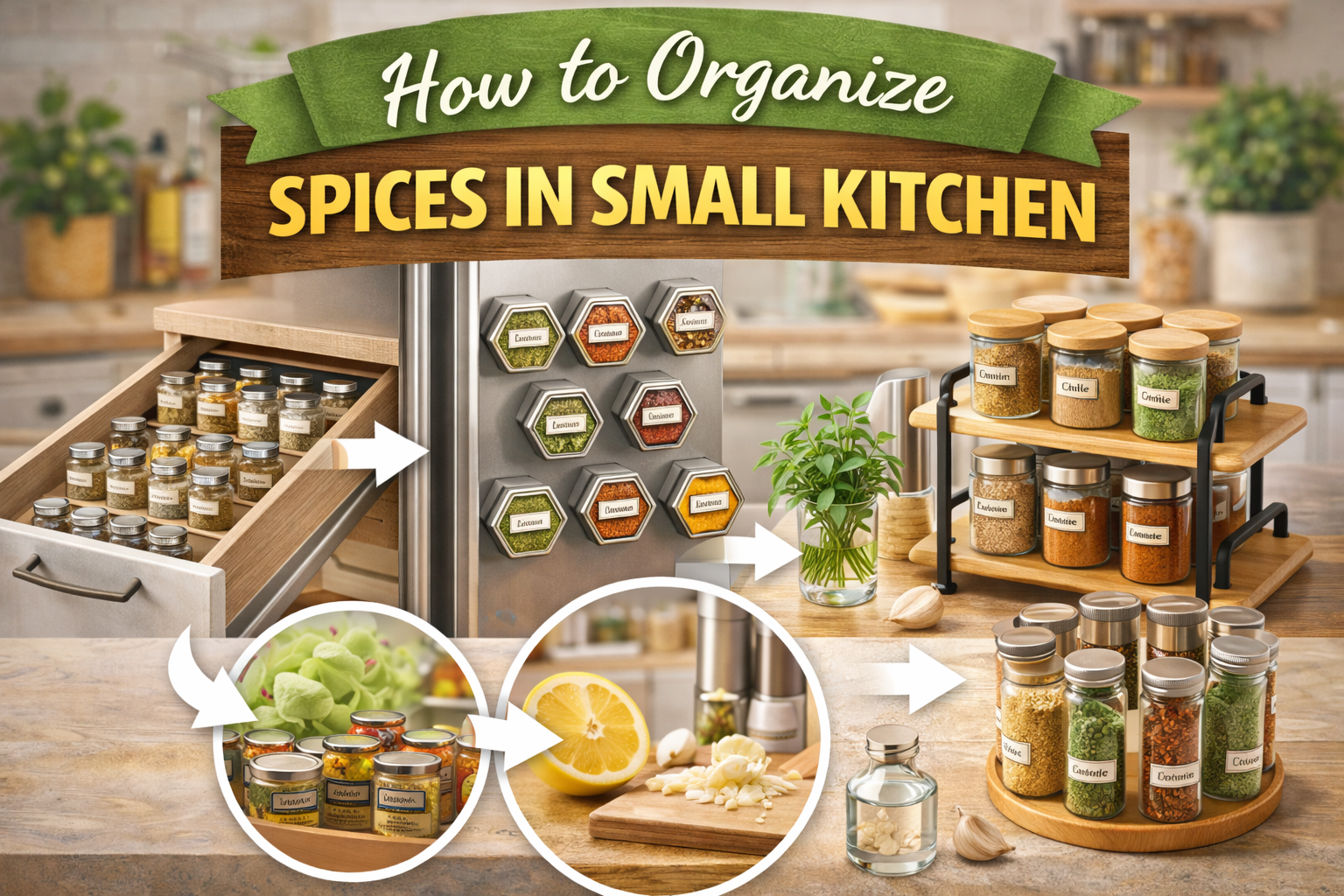
How to Organize Spices in Small Kitchen : In the culinary world, spices are the difference between nourishment and an experience. They are the soul of a dish, the whispers of distant lands, and the secret weapons of home cooks everywhere. Yet, in the confines of a small kitchen, these tiny, powerful containers can quickly become a source of immense frustration. The dreaded “spice cabinet” often devolves into a chaotic black hole where cumin seeds mingle with cinnamon sticks, and you find yourself pulling out fourteen jars to find the paprika buried at the back. This disorganization leads to duplicate purchases, wasted money, and meals that lack that final, perfect flourish because you simply couldn’t find the required ingredient in time.
Living in a small kitchen does not mean you have to surrender to spice chaos. It simply requires a shift in perspective, a dose of creativity, and a strategic approach to the space you have. This comprehensive guide will walk you through every step of the journey, from purging your collection to choosing the perfect storage system and implementing a maintenance routine that ensures your spices remain accessible, fresh, and beautifully organized. By the end, your spice collection will no longer be a source of stress but a curated, inspiring, and highly functional part of your culinary workspace.
See More : How to Get Rid of Kitchen Odor Naturally
Part 1: The Great Purge – A Fresh Start
Before you can organize, you must declutter. Attempting to organize a collection of old, half-empty, and duplicate spice jars is like trying to arrange a messy room without taking out the trash first. This initial step is crucial for creating a manageable and useful collection.
- Gather Everything: The first step is a comprehensive retrieval mission. Search every nook and cranny of your kitchen. Look in the designated spice cabinet, the pantry shelves, random kitchen drawers, countertop caddies, and even the back of the refrigerator door if you store certain items there. Gather every single jar, bag, and tin onto your kitchen table or counter. This visual of the “spice herd” is often shocking but necessary.
- Check for Freshness: Spices are not immortal. They are dried plant matter, and over time they lose their volatile oils, which are the very essence of their flavor and aroma. A simple freshness test involves taking a small amount in your palm and crushing it or rubbing it. If the aroma is faint or smells like dust or nothing at all, it’s time for it to go. As a general rule, ground spices lose their potency after 1-2 years, while whole spices (like cumin seeds, peppercorns, or cinnamon sticks) can last 3-4 years if stored properly.
- Check for Quality: Inspect each container. Are there any signs of moisture, clumping, or mold? Has the color faded significantly? Are there any tiny pantry pests? Any questionable items should be discarded immediately to protect the rest of your collection.
- Consolidate Duplicates: This is a common occurrence in disorganized kitchens. You will likely find two half-full jars of oregano or three different containers of chili powder. Consolidate these into a single container. If they are from different brands or of different ages, it’s best to use your senses. If they smell and look identical, combine them. If one is clearly older or of lower quality, discard the lesser one. The goal is to have one jar for each distinct spice.
- Be Honest About Usage: This is the most difficult but rewarding part of the purge. Be honest with yourself about what you actually cook. Did you buy that jar of sumac for a single recipe two years ago and never touch it since? Did you purchase a large bag of dried lavender for a baking project that never happened? If you haven’t used a spice in over a year and it’s not a staple for future planned recipes, it is taking up valuable real estate. Consider giving it to a friend who cooks, or, if it’s past its prime, thank it for its service and let it go.
Once you have a curated pile of fresh, useful, and beloved spices, you are ready to move on to the next critical step: choosing your vessels.
Part 2: The Vessel Dilemma – Uniformity is Key
The single most impactful change you can make for spice organization is to transfer your spices into a uniform set of containers. The mishmash of cardboard boxes, twist-tie bags, and oddly shaped jars from different brands is the primary cause of visual chaos and inefficient storage.
The Case for Uniform Jars:
- Maximizes Space: Rectangular or square jars can fit together tightly without wasted gaps, unlike round jars which leave empty spaces between them. This allows you to store more spices in a smaller footprint .
- Visual Clarity: A row of identical jars is inherently calming and organized. Your eye can scan them quickly and easily, finding what you need in an instant.
- Easy Labeling: Uniform jars allow for a consistent, easy-to-read labeling system, which is the backbone of any good organization.
Choosing Your Jar:
- Material: Glass is the superior choice for spice storage. It is non-porous, doesn’t retain odors, is easy to clean, and provides an airtight seal. Avoid plastic, as it can absorb odors and is less durable.
- Shape:
- Square or Rectangular Jars: These are the space-maximizing champions. They fit together like little bricks, allowing you to create dense, efficient rows. They are perfect for drawers or shallow cabinets .
- Round Jars: These are classic and aesthetically pleasing, especially for countertop racks. However, they are less space-efficient for drawer or cabinet storage.
- Shallow Tins: Small, flat tins with lids can be excellent for storing in shallow drawers. They stack neatly and can be easily labeled on the top.
- Size: Standard spice jars typically hold between 2 to 4 ounces. Consider your cooking habits. If you buy spices in bulk, you might want a few larger jars for your most-used staples (like black pepper, garlic powder, or paprika) and standard-sized jars for the rest.
- Lid Type: This is a matter of personal preference.
- Standard Screw-Top Lids: These are simple, airtight, and allow you to use your own measuring spoons.
- Shaker Tops: Jars with built-in shaker tops (like a perforated lid) are incredibly convenient for spices you sprinkle frequently, such as garlic powder or dried herbs. Some jars come with a two-piece lid: a solid inner disk for storage and a shaker top for use.
The Labeling Imperative:
Once your spices are in uniform jars, labeling is non-negotiable. Without a clear label, your beautiful system is just a collection of anonymous powders.
- What to Label With: A simple label maker produces crisp, clean, professional-looking labels. Waterproof chalk labels or chalk pens allow you to write directly on glass and can be easily wiped clean and rewritten if you change the spice. Simple adhesive craft labels work well too.
- What to Put on the Label: At minimum, the name of the spice. Many people also find it helpful to include the purchase or “packaged on” date to track freshness. For extra organization, you could use a small symbol (like a chili pepper for hot spices) but this is optional.
- Label Placement: Consistency is key. Labels should always be on the same part of the jar—either the top or the front—so you can find what you need at a glance without having to rotate each jar.
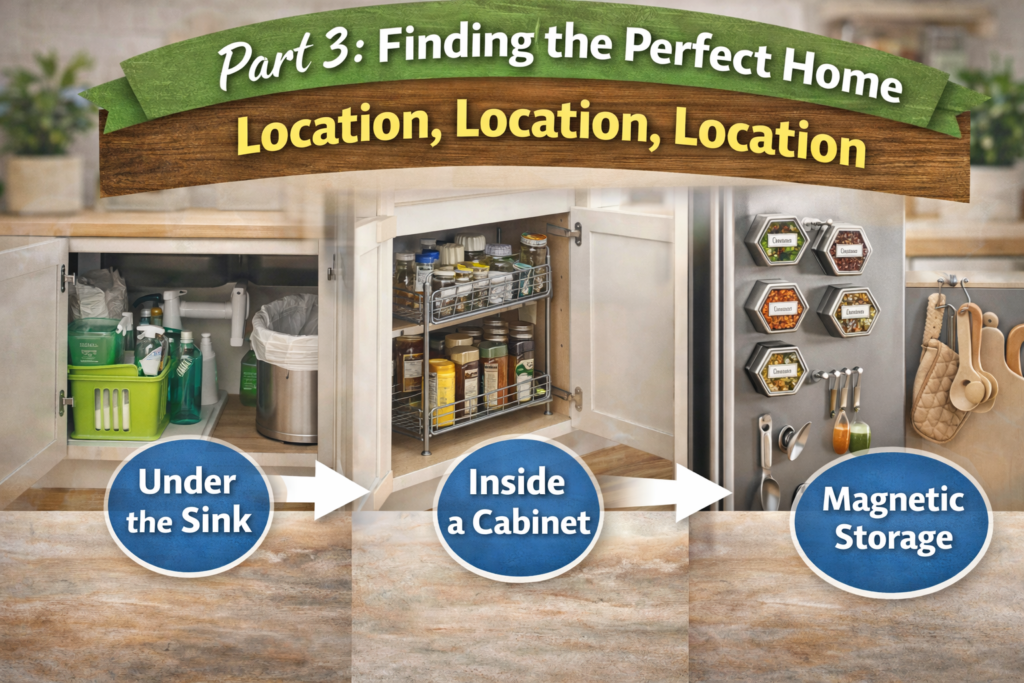
Part 3: Finding the Perfect Home – Location, Location, Location
With your curated, uniform collection ready, the next question is where to put them. In a small kitchen, every inch counts, and the best location is one that balances accessibility with space conservation.
Prime Real Estate: The Golden Zone
The ideal spot for your spices is within arm’s reach of your primary food preparation area. You want to be able to grab cumin while you’re stirring a pot, not have to walk across the kitchen to the pantry. This “golden zone” is typically the area between your stove and your sink or prep space. However, there is one major caveat: heat and light are enemies of spices. Never store spices directly above the stove or next to the oven, as the constant heat and steam will rapidly degrade their essential oils. A cabinet or drawer next to the stove, but not above it, is a much better option.
Top Storage Solutions for Small Kitchens:
- The Drawer of Dreams: A deep kitchen drawer is one of the most underutilized and perfect spaces for spice storage. Laying jars flat allows you to see every label at a glance, like records in a crate.
- Method: Install expandable bamboo drawer dividers or purchase a custom drawer insert designed for spice jars. You can then arrange your square or round jars in neat rows. This method keeps them out of sight, protected from light, and incredibly accessible .
- The Door of Opportunity: The inside of a cabinet door is a blank canvas of valuable vertical storage.
- Method: Install adhesive wire racks, small shelves, or elastic fabric organizers specifically designed for cabinet doors. This is a fantastic way to store smaller jars or frequently used spices, keeping them off the shelves and freeing up interior space .
- The Wall Gallery: If you have an empty stretch of wall in your kitchen, vertical space is there for the taking.
- Method: Install floating magnetic spice racks (if you have metal lids) or simple wooden shelves to create a visible and artistic display of your jars. Ensure the wall is not in direct sunlight to protect the spices. This method keeps your spices visible and adds a decorative, cookbook-like element to your kitchen .
- The Tiered Shelf Solution: If you must use a standard cabinet shelf, tiered shelves or risers are a game-changer.
- Method: Place a tiered shelf inside your cabinet. This creates stadium seating, allowing you to see the spices in the back row just as easily as the ones in the front. No more lost jars hiding behind taller bottles .
- The Under-Cabinet Bracket: The space between the countertop and the upper cabinets is often unused.
- Method: Install a slim metal or wooden rail system under the cabinets from which you can hang small jars or hooks. This keeps spices within the golden zone but out of the way of your countertop workspace .
- The Rolling Cart: A narrow, wheeled cart that can fit in a slim gap between your counter and the wall or refrigerator provides mobile, extra storage. You can dedicate a shelf or two to spices and wheel the cart out when you need access .
Part 4: Choosing Your Organizational Philosophy – Alphabetical vs. Categorical
Once you have chosen your storage location and method, the final organizational decision is how to arrange the spices themselves. There are two primary schools of thought, and the best one for you depends on your cooking style and how your brain works.
Method 1: The Librarian’s Way – Alphabetical Order
This is the most straightforward and objective system. You simply arrange all your spices from A to Z (Allspice, Basil, Cumin, etc.).
- Pros: It is universally understandable. Anyone in your household can find and return a spice to its correct spot without any training. It eliminates the guesswork of deciding which category a spice belongs to (e.g., Is curry powder an Indian spice or a blend?).
- Cons: It can separate spices you commonly use together. For example, chili powder, cumin, and oregano (a common taco seasoning combo) might be scattered in different parts of your collection. This can slow you down during active cooking.
Method 2: The Chef’s Way – Categorical or By Cuisine
This system groups spices based on how they are used.
- By Cuisine: Create zones for Italian herbs (oregano, basil, thyme, rosemary), Mexican spices (chili powder, cumin, oregano), Indian spices (cumin seed, coriander, turmeric, cardamom), Baking spices (cinnamon, nutmeg, cloves, ginger), and Savory All-Purpose (garlic powder, onion powder, paprika, black pepper).
- By Frequency of Use: Place your most-used spices (salt, pepper, garlic powder, your favorite all-purpose blend) in the most accessible spot, with less frequently used spices in a secondary location.
- Pros: This method is incredibly intuitive for cooking. When you decide to make spaghetti, you go directly to the “Italian” zone and have everything at your fingertips. It creates a workflow that mirrors your cooking patterns.
- Cons: It can be subjective. Where does a versatile spice like oregano go? It’s Italian, but also great in Mexican and Greek food. This requires you to make a decision and be consistent.
The Hybrid Approach:
Many find the best system is a blend. For example, you could keep all your spices alphabetical, but within that system, use a small, separate caddy or the front row of your drawer for your top 5-10 most frequently used spices. This gives you the precision of alphabetization with the convenience of a “chef’s mise en place.”
Part 5: Thinking Outside the Cabinet – Creative Ideas for Tiny Kitchens
When square footage is at an absolute premium, you have to get creative and look at everyday objects in a new light. Here are some ingenious, space-saving ideas for spice storage.
- The Magazine Holder: A simple, beautiful metal or wood magazine holder placed on its side on a countertop or an open shelf can be a perfect home for spice jars. It corrals them neatly, prevents them from falling over, and you can see the labels by flipping through them like records .
- The Picture Ledge: Installing a narrow picture ledge (the kind used to display art) on a wall creates a slim shelf perfect for a single row of small jars. It’s decorative and functional .
- The CD Rack: An old wall-mounted CD or DVD rack, with its narrow slots, is ideally sized for holding rows of small spice jars.
- The Test Tube Rack: For the truly tiny collection or for those who buy in very small quantities, a lab-style test tube rack can hold small vials of spices and looks incredibly chic and modern.
- Magnetic Spice Tins: Purchase small, shallow metal tins with clear lids. Attach a strong magnetic strip to the inside of a cabinet door, the side of your refrigerator, or even a metal backsplash. Your spices become a magnetic gallery, instantly accessible and completely out of the way .
- Repurposed Drawer Organizers: Don’t limit yourself to the kitchen section. Check office supply or craft stores for small parts organizers, hardware bins, or bead storage boxes. These can be perfect for holding tiny bags of spices or for organizing packets of spice blends.
Part 6: The Art of Maintenance – Keeping the System Alive
You have purged, decanted, labeled, and arranged. You have created a spice sanctuary. The final, and perhaps most important, step is to implement a simple maintenance routine to ensure your system doesn’t slowly devolve back into chaos.
- The One-In, One-Out Rule: This is a golden rule of organization. When you buy a new spice to replace an old one, discard the old container immediately. When you buy a spice you don’t currently have, find a home for it within your system. This prevents overflow and accumulation.
- Clean as You Go: Get in the habit of wiping down your jars and your storage area when you do your regular kitchen cleaning. A quick wipe prevents sticky residue from building up.
- The Monthly Five-Minute Tidy: Once a month, take five minutes to scan your spice collection. Are any jars out of place? Return them. Is there a spill in the drawer? Wipe it up. This tiny investment of time prevents the need for a future, hours-long reorganization.
- Resist the Urge to Buy Bulk (Unless You Have a Plan): Bulk buying is economical, but in a small kitchen, it can be a curse. Only buy bulk spices if you have a plan to repackage them into smaller daily-use jars and store the bulk remainder in a separate, designated area (like a high pantry shelf) in an airtight bag or container.
- Review Your Collection Seasonally: Every few months, take a quick sniff test of your spices, especially the ones you use less often. If something has lost its aroma, it’s time to replace it and let go of the old jar.
Part 7: A Step-by-Step Summary for Your Project
To make this entire process actionable, here is a streamlined checklist you can follow on your spice organization day.
- The Hunt: Gather every single spice from everywhere in your kitchen.
- The Audit: Check for freshness (smell test), quality (clumping, pests), and duplicates.
- The Decision: Be honest about what you actually use. Donate or discard the rest.
- The Vessel Selection: Choose and purchase uniform, airtight glass jars (square for drawers/cabinets, round for racks). Decide on your labeling method.
- The Decanting: Transfer your keeper spices into the new jars. Fill them, but not to the very brim. Seal tightly.
- The Labeling: Label every single jar clearly and consistently.
- The Location Scouting: Assess your small kitchen. Is a deep drawer available? A cabinet door? A bare wall? Choose your spot based on accessibility and protection from heat/light.
- The Installation: Install your chosen storage solution (drawer dividers, door racks, shelves, etc.).
- The Arrangement: Arrange your jars according to your chosen philosophy (alphabetical, categorical, or hybrid).
- The Celebration: Step back and admire your beautifully organized, functional spice collection.
Conclusion ( How to Organize Spices in Small Kitchen )
Organizing spices in a small kitchen is a puzzle, but it is a puzzle with a deeply satisfying solution. It is an exercise in intentional living, forcing you to curate, prioritize, and think creatively about the space you have. By moving beyond the chaos of mismatched containers and embracing a system of uniform jars, strategic placement, and consistent labeling, you transform a source of daily frustration into a wellspring of culinary inspiration.
Your spices are no longer a cluttered afterthought but a thoughtfully arranged library of flavor, ready to be consulted at a moment’s notice. You will cook with more confidence, waste less food and money, and experience the simple joy of opening a cabinet or drawer to find everything perfectly in its place. In the small kitchen, where every square inch matters, an organized spice collection is not just a luxury—it is a testament to the power of good design and the key to unlocking your full potential as a home cook.
9 thoughts on “How to Organize Spices in Small Kitchen”