Best Containers for Kitchen Storage : The humble container. It seems so simple—a vessel to hold food, to keep it fresh, to make it accessible. Yet the world of kitchen containers is vast and confusing. Glass or plastic? Airtight or vented? Round or square? Stackable or nested? The choices seem endless, and the wrong choice leads to frustration—containers that don’t fit, lids that disappear, food that spoils prematurely.
Choosing the right containers for your kitchen is not about following trends or buying the most expensive options. It’s about understanding your specific needs, your cooking habits, your storage space, and your budget. The best container for one kitchen may be entirely wrong for another.
This guide cuts through the confusion. It explains the different types of containers available, their advantages and disadvantages, and the best uses for each. It provides clear criteria for making decisions and recommends specific containers for different storage needs. Whether you’re organizing dry goods, storing leftovers, or packing lunches, you’ll find the information you need to choose wisely.
Read More : How to Deep Clean Kitchen Sink Step by Step
How to Store Leftover Food Safely
How to Prevent Ants in Kitchen Naturally
How to Get Rid of Kitchen Odor Naturally
How to Keep Vegetables Fresh for Longer in Fridge
1. Understanding Container Materials: Glass vs. Plastic vs. Others
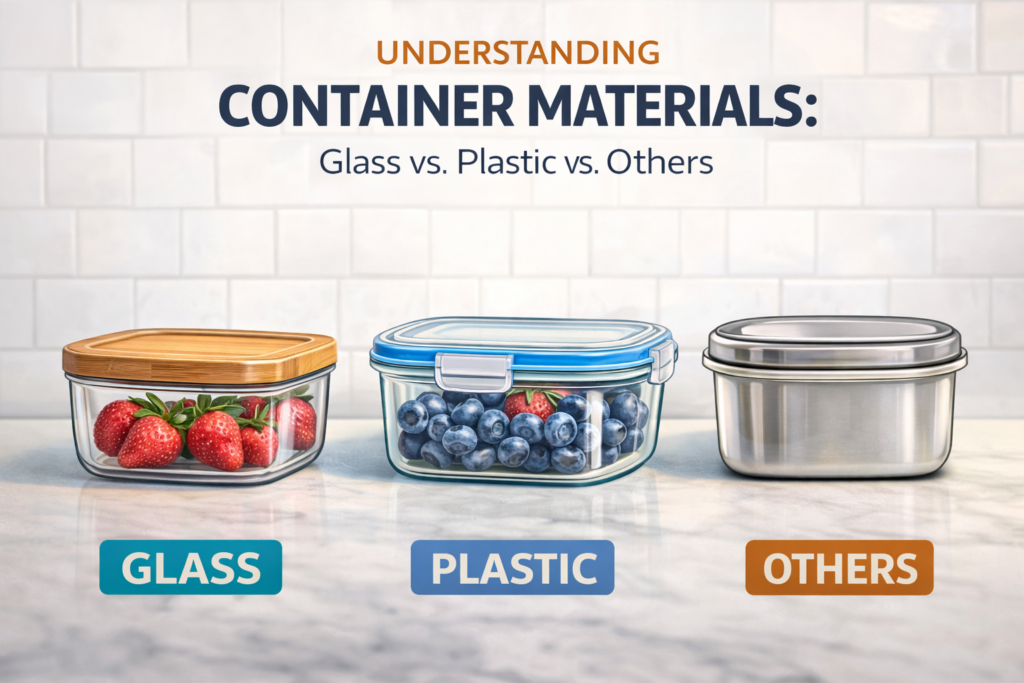
The material of a container determines its durability, functionality, and suitability for different uses. Each material has distinct advantages and trade-offs .
Glass containers offer several significant benefits. They don’t absorb stains or odors, no matter how many times you store tomato sauce or curry. They’re microwave-safe (without the lid), oven-safe (check temperature limits), and dishwasher-safe. They’re non-porous and don’t harbor bacteria. They’re transparent, so you can see contents at a glance. And they’re endlessly recyclable at the end of their long life .
The downsides of glass are weight and fragility. Glass containers are heavier than plastic, which matters if you carry your lunch daily. They can break if dropped, though tempered glass is surprisingly durable. They’re also generally more expensive than plastic .
Plastic containers are lightweight, unbreakable, and inexpensive. They come in countless shapes and sizes. Modern BPA-free plastics are safe for food storage. They’re ideal for lunch boxes, for children, for any situation where weight and durability matter .
The downsides of plastic are significant. Plastic can stain—that tomato sauce may leave orange traces forever. It can absorb odors—your container might smell like curry long after the curry is gone. It can warp in the dishwasher or microwave. It degrades over time, becoming cloudy and brittle. And plastic has environmental impacts, both in production and at end of life .
Stainless steel containers offer durability and lightness without the concerns of plastic. They’re unbreakable, don’t stain or absorb odors, and are environmentally friendly. They’re ideal for lunch boxes and for outdoor use .
The downsides of steel are opacity—you can’t see contents without opening—and microwave incompatibility. Steel cannot go in the microwave, which may be inconvenient for reheating .
Silicone containers are flexible, collapsible, and space-saving. They’re heat-resistant, freezer-safe, and dishwasher-safe. They’re ideal for situations where space is limited .
The downsides of silicone are lack of structure—they don’t stack well—and potential for tipping when full. Quality varies widely; cheap silicone may have off-gassing issues .
2. Airtight vs. Standard: When Seal Matters
The seal quality of a container dramatically affects its performance. Understanding when you need airtight and when standard suffices saves money and improves function .
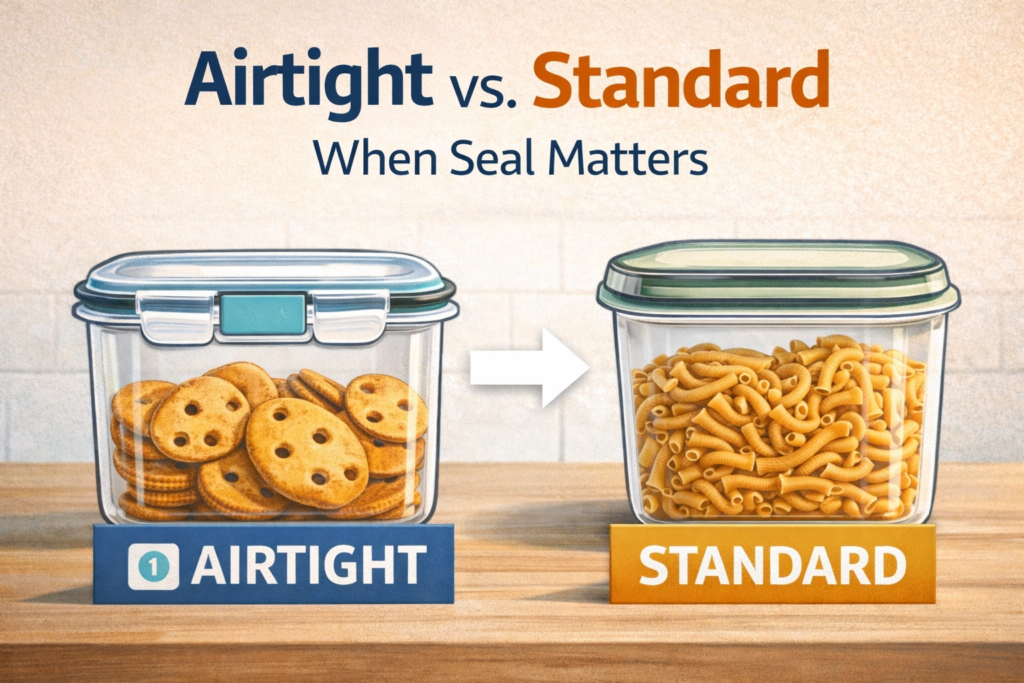
Airtight containers create a complete seal that prevents air exchange. This is essential for:
- Dry goods that can go stale: flour, sugar, cereal, crackers, cookies
- Items that absorb odors: delicate spices, tea, coffee
- Items that emit odors: onions, garlic, strong spices
- Freezer storage, where air causes freezer burn
- Pantry items that attract pests: grains, nuts, dried fruit
True airtight containers typically have silicone gaskets and locking mechanisms. They’re more expensive but worth it for the applications above .
Standard containers with snap-on lids provide adequate sealing for many uses:
- Refrigerator leftovers, which will be eaten within days
- Cut fruits and vegetables, which need some air circulation
- Items in daily use that won’t sit long enough to stale
For these applications, the extra expense of true airtight seals is unnecessary. Simple, well-fitting lids work fine .
3. Shape Matters: Round vs. Square vs. Rectangular
Container shape affects both storage efficiency and usability. The right shape depends on where and how you’ll use them .
Square and rectangular containers maximize space efficiency. They pack tightly together with no wasted space between them. On shelves, they use every inch. In lunch boxes, they fit neatly. For pantry storage of dry goods, square containers are almost always the best choice .
The downside of square containers is cleaning corners, which can trap food. High-quality containers have rounded interior corners that mitigate this issue .
Round containers are often more aesthetically pleasing and easier to clean—no corners to scrub. They’re ideal for leftovers that will be eaten soon, for mixing and serving, and for situations where appearance matters .
The downside of round containers is space inefficiency. On a shelf, round containers leave triangular gaps that waste space. In refrigerators, they don’t pack as efficiently .
Specialty shapes exist for specific purposes. Tall, narrow containers work for pasta or linguine. Short, wide containers work for leftovers that need quick reheating. Choose shapes that match your specific needs .
4. Nesting and Stackability: Space-Saving Considerations
In small kitchens, how containers store when not in use matters as much as how they store food. Nesting and stackability are key considerations .
Nesting containers fit inside each other when empty. This is ideal for space-constrained kitchens where you need many sizes but have limited cabinet space. Sets that nest neatly can store an entire collection in the space of one container .
The trade-off is that nested containers are rarely uniform in shape, which may affect how efficiently they store food. But for many households, the space savings when empty outweigh this consideration .
Stackable containers have identical footprints and stack securely when full. This maximizes space efficiency in refrigerators, freezers, and pantries. Square or rectangular containers with straight sides stack most efficiently .
Look for containers with recessed lids that create stable stacking platforms. Some systems have interlocking features that prevent stacks from tipping .
Modular systems offer both nesting and stackability. These are sets designed to work together—different sizes with compatible footprints, lids that fit multiple containers, and nesting capability when empty. These systems are worth the investment for serious home cooks .
5. Dry Goods Storage: Pantry Essentials
Storing dry goods properly extends freshness, prevents pest infestations, and makes cooking easier. The right containers transform pantry organization .
For staples like flour, sugar, rice, and pasta, choose clear, airtight containers. Glass is ideal because it doesn’t absorb odors and shows contents clearly. Square containers maximize shelf space. Look for wide mouths for easy access and pouring .
For flour, consider containers with gasket seals that keep moisture out. Flour can absorb humidity and clump; airtight protection is essential .
For sugar, moisture protection is also important. Brown sugar, in particular, needs airtight storage to prevent hardening .
For pasta, tall, narrow containers work well. They keep pasta upright and accessible without taking much shelf space. Some containers have pour spouts for easy dispensing .
For cereals and snacks, consider containers that are easy for children to access. Lightweight plastic with simple lids may be better than heavy glass in this case .
For baking supplies—baking soda, baking powder, yeast—airtight is essential. These ingredients lose potency quickly when exposed to air. Small, airtight containers with clear labels keep them fresh .
6. Refrigerator Storage: Keeping Food Fresh
Refrigerator storage has different requirements than pantry storage. Temperature fluctuations, humidity, and the need for quick access all matter .
For leftovers, choose containers that are microwave-safe for easy reheating. Glass is ideal because it transitions from refrigerator to microwave to table. Square shapes pack efficiently on refrigerator shelves .
For cut fruits and vegetables, consider containers with vented lids that allow some air circulation. This prevents moisture buildup that leads to spoilage. Some containers have adjustable vents for different produce types .
For deli meats and cheeses, shallow containers work well. They allow you to see contents at a glance and prevent items from getting lost at the back .
For opened cans, never store food in the can once opened. Transfer to a proper container. Small glass jars work well for single servings .
For yogurt, sour cream, and similar items, the original containers are usually fine for short-term storage. But for longer storage, transfer to containers with tight-sealing lids .
7. Freezer Storage: Preventing Freezer Burn
Freezer storage requires special consideration. Air is the enemy—it causes freezer burn that degrades quality. Containers for the freezer must be truly airtight .
For soups, stews, and sauces, consider rigid containers with airtight seals. Leave headroom for expansion as the liquid freezes. Square containers stack efficiently in freezers .
For meats and fish, vacuum-sealed bags are ideal but not always practical. Airtight containers with minimal air space work well. Wrap items tightly or use containers sized to fit the portion .
For berries and vegetables, consider freezing in a single layer on a tray first, then transferring to containers. This prevents clumping and allows you to remove just what you need .
For frozen meals, individual portion containers are convenient. Choose microwave-safe containers so meals can go directly from freezer to microwave .
Always label freezer containers with contents and date. Frozen food all looks similar, and memory fades. A simple label saves mystery later .
8. Lunch Containers: Portable and Practical
For those who pack lunches, containers must be portable, leak-proof, and easy to clean. The right choices make daily packing easier .
For main dishes, consider divided containers that keep different foods separate. Adults may prefer grown-up versions; children may like colorful, compartmentalized bento boxes .
For soups and liquids, leak-proof is essential. Containers with screw-top lids and silicone gaskets provide the best protection against spills. Test before trusting in a bag .
For salads, consider containers with built-in dressing compartments that keep greens from getting soggy. These allow you to add dressing just before eating .
For snacks, small containers in various sizes allow portion control and variety. A set of small, uniform containers makes packing easy .
For hot foods, insulated containers keep food warm until lunchtime. These are ideal for soups, stews, and leftovers that need to stay hot .
9. Spice Storage: Small Containers, Big Impact
Spices are small but essential. Proper containers keep them fresh and accessible. The right system transforms cooking .
For bulk spices you buy in quantity, consider small, airtight jars. Uniform jars with labels visible from above make finding the right spice quick. Square jars pack efficiently; round jars are classic .
For spices you use frequently, consider easy-access containers. Some have flip-top lids for one-handed dispensing while cooking. Others have shaker tops for even sprinkling .
For spice packets and bags, transfer to jars. Packets are difficult to store and don’t seal well after opening. Small jars with airtight lids keep spices fresh .
For labeling, consider labels on both the top and side. Top labels allow identification at a glance when jars are stored in a drawer or on a shelf. Side labels work for open shelving .
Consider the location of your spice storage. If you store spices in a drawer, short, wide jars work best. If on a shelf, taller jars may be better .
10. Baking Supplies: Specialized Storage
Baking requires specific ingredients that benefit from specialized storage. The right containers make baking easier and more enjoyable .
For flour and sugar, large, airtight containers are essential. Consider containers with pour spouts for easy dispensing. Some have measurement markings on the side .
For brown sugar, consider a container designed to keep it soft. Some have terra-cotta discs that you soak in water to maintain humidity. Airtight storage alone isn’t enough for brown sugar .
For powdered sugar and confectioners’ sugar, containers with shaker tops allow easy dusting. The same container can store and dispense .
For chocolate chips, nuts, and dried fruit, medium-sized containers with airtight seals keep them fresh. Portioning is easier when you can see what you have .
For baking powder and baking soda, small, airtight containers are essential. These ingredients lose potency quickly when exposed to air. Replace them regularly .
11. Specialty Containers for Specific Needs
Beyond the basics, specialty containers address specific storage challenges. These are worth considering for your particular needs .
Produce keepers are designed specifically for fruits and vegetables. They have vents that regulate humidity and keep produce fresh longer. Some have raised baskets that keep produce above excess moisture .
Bread boxes keep bread fresh without refrigeration. The enclosed space maintains ideal humidity. For those who bake or buy fresh bread, a bread box is worthwhile .
Cheese storage containers are designed to maintain ideal humidity for cheese. They allow cheese to breathe while preventing it from drying out. Some have adjustable vents .
Oil and vinegar dispensers with pour spouts make cooking easier. Look for dark glass to protect oil from light, which causes rancidity. Avoid plastic for oil storage .
Fermentation crocks for those who make their own sauerkraut, kimchi, or pickles. These specialized containers have water seals that allow gases to escape while keeping air out .
12. Container Systems: Cohesive vs. Collected
The final consideration is whether to buy a matching system or collect containers piecemeal. Both approaches have merits .
Matching systems offer several advantages. Containers stack perfectly. Lids are interchangeable. The look is cohesive and visually calm. Shopping is simple—buy a set and you’re done .
The downside is that sets may include sizes you don’t need or lack sizes you do. You’re locked into one brand for expansion. And quality sets can be expensive .
Collected containers allow you to choose exactly what you need. You can mix materials based on use—glass for pantry, plastic for lunch, stainless for outdoor. You can acquire gradually, spreading cost over time .
The downside is that collected containers may not stack well together. Lids may not interchange. The look may be chaotic. Organization requires more thought .
A hybrid approach often works best: choose a matching system for one category (like pantry dry goods) and collect individually for others (like lunch containers) .
| Container Type | Best Material | Key Features | Typical Uses |
|---|---|---|---|
| Dry Goods Storage | Glass | Airtight, square, clear | Flour, sugar, rice, pasta, cereal |
| Leftover Storage | Glass | Microwave-safe, stackable | Cooked food, meal prep |
| Freezer Storage | Plastic or glass | Airtight, freezer-safe | Soups, stews, meats, frozen meals |
| Lunch Containers | Plastic or stainless | Leak-proof, portable, divided | Packed meals, snacks |
| Spice Jars | Glass | Airtight, uniform, label-friendly | Spices, herbs, seasoning blends |
| Produce Keepers | Plastic | Vented, humidity-controlled | Fruits, vegetables |
| Baking Supplies | Glass or plastic | Large capacity, pour spouts | Flour, sugar, chocolate chips |
| Sauce and Dressing | Glass | Pour spouts, airtight | Oils, vinegars, homemade dressings |
| Snack Containers | Plastic | Small, portion-controlled | Nuts, dried fruit, crackers |
| Bread Box | Metal or ceramic | Enclosed, ventilated | Fresh bread, baked goods |
| Cheese Storage | Plastic or ceramic | Humidity-controlled | Cheese blocks, wedges |
| Fermentation Vessels | Glass or ceramic | Water seal, non-reactive | Sauerkraut, kimchi, pickles |
Choosing What’s Right for You
With so many options, choosing the right containers can feel overwhelming. Focus on your specific needs and cooking habits .
Consider what you store most. If you buy in bulk, large containers for pantry staples are priority. If you cook for one, small leftover containers matter more. If you pack lunches, portable containers come first .
Consider your space. Small kitchens benefit from nesting containers and square shapes that maximize efficiency. Larger kitchens can accommodate round, aesthetic choices .
Consider your budget. You don’t need to buy everything at once. Start with the containers that will make the biggest difference in your daily cooking, and add gradually .
Consider your values. If environmental impact matters, glass and stainless steel are better choices than plastic. If weight matters, plastic may be necessary .
Care and Maintenance
Good containers last for years with proper care. Follow manufacturer instructions, but general principles apply .
Glass is dishwasher-safe and oven-safe (check temperature limits). Avoid extreme temperature changes—don’t put a hot glass container in cold water .
Plastic should be washed gently. Dishwasher heat can warp plastic and degrade seals. Hand-washing extends plastic life. Replace plastic when it becomes cloudy or scratched .
Seals and gaskets need attention. Remove them periodically for thorough cleaning. Food trapped under seals can mold. Replace worn seals to maintain airtightness .
Lids eventually wear out. Many manufacturers sell replacement lids, extending the life of containers. Check before discarding a container with a worn lid .
Conclusion : Best Containers for Kitchen Storage
The best containers for your kitchen are the ones that meet your specific needs, fit your space, and suit your habits. There is no universal “best”—only what works best for you .
Understanding materials, seal requirements, shapes, and specialized options allows you to make informed choices. Considering your cooking habits, storage space, and budget guides you toward the right investments. Caring for your containers properly extends their life and protects your food .
Start by assessing what you store most and where your current system frustrates you. Choose a few high-quality containers that address those frustrations. Live with them, learn what works, and gradually build a collection that serves you well .
The right containers make cooking easier, food fresher, and your kitchen more organized. They’re an investment in your daily life, worth choosing thoughtfully. With this guide, you have the knowledge to choose wisely .