Creative Storage Solutions for Small Kitchens : The small kitchen presents a delightful paradox. It forces constraints upon us—limited counter space, minimal cabinets, nowhere to put the things we need—yet these very constraints spark creativity. When square footage is scarce, ingenuity becomes essential. The result is often a kitchen that works harder, smarter, and more efficiently than its spacious counterparts, simply because it must.
Living with a small kitchen teaches you things that owners of large kitchens never learn. You learn that you don’t actually need fourteen plates. You learn that vertical space is just as valuable as horizontal. You learn that the right organizer can double your storage capacity. You learn that every inch counts, and that the most creative solutions often come from looking at familiar spaces in entirely new ways.
The ideas that follow represent the accumulated wisdom of countless small kitchen dwellers who have faced the challenge of too much stuff and too little space. They range from the obvious to the ingenious, from solutions that cost nothing to investments that pay dividends in organization. Some require DIY skills; others need nothing more than a trip to the hardware store. All of them share a common goal: helping you store more in less space without sacrificing accessibility or style.
Read More : Smart Drawer Organization Ideas for Kitchen
Minimalist Kitchen Organization Guide for Beginners
How to Keep Vegetables Fresh for Longer in Fridge
1. Vertical Space: The Most Underutilized Resource
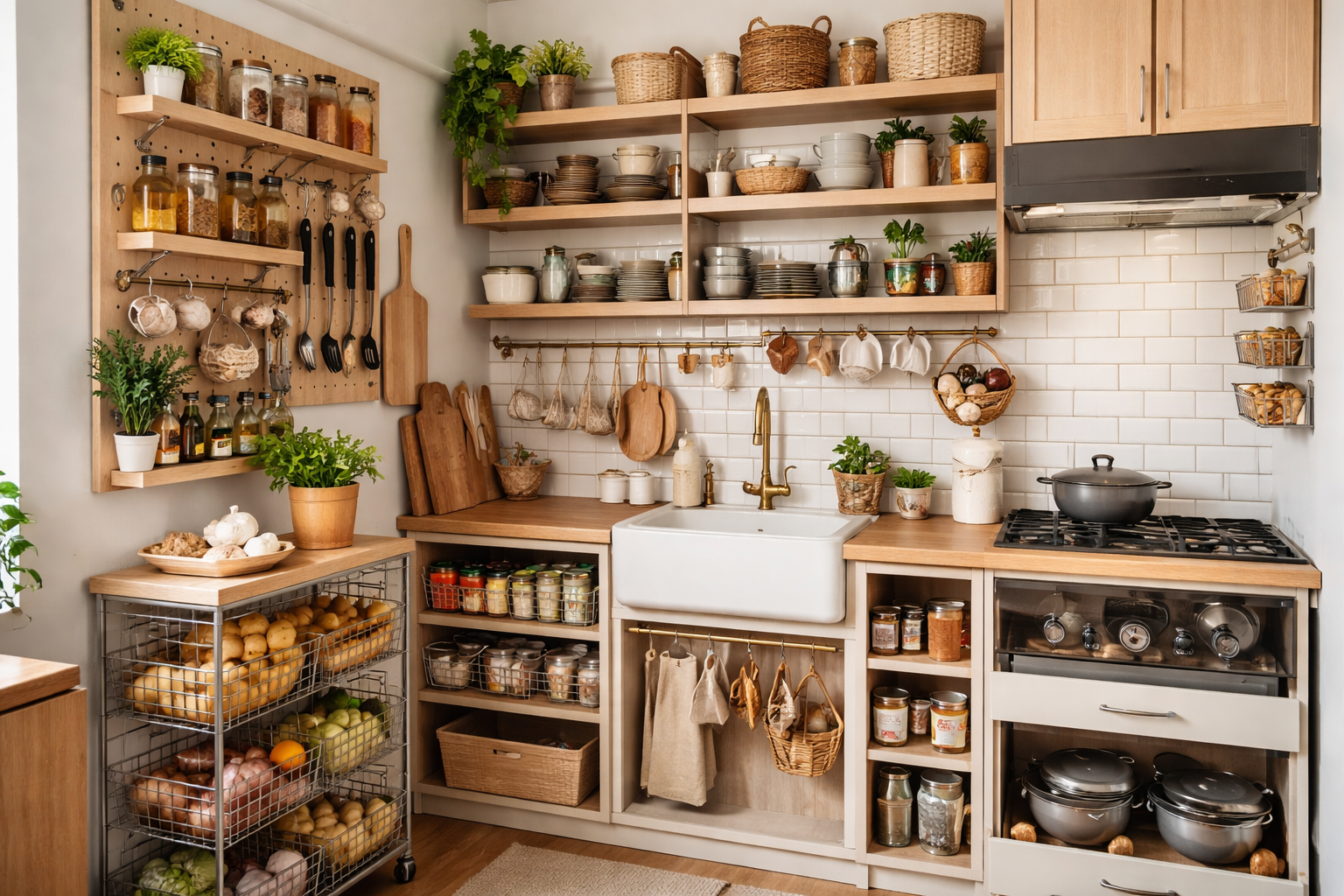
In a small kitchen, floor space and counter space are precious, but wall space often goes completely unused. The vertical plane represents untapped storage potential that can transform your kitchen’s capacity without consuming any of the limited horizontal surfaces .
The simplest vertical solution is open shelving. Installing floating shelves on empty wall space provides storage for dishes, glasses, and frequently used ingredients. Open shelves force you to curate what you display—they work best for attractive items you use regularly. The visual weight of items on open shelves draws the eye upward, making the kitchen feel larger .
For a more dramatic vertical solution, consider floor-to-ceiling shelving. A tall unit against one wall provides enormous storage in a small footprint. Use it for pantry items, cookbooks, small appliances, and decorative elements. The height draws the eye upward, emphasizing the room’s vertical dimension rather than its limited floor space .
Pegboards have migrated from garages to kitchens as versatile vertical storage. A pegboard mounted on an empty wall, fitted with hooks and small shelves, can hold an astonishing amount of gear while keeping everything visible and accessible. The beauty of pegboard is its flexibility—as your needs change, you simply move the hooks .
Magnetic strips offer another elegant vertical solution. Mounted on the wall or backsplash, they can hold knives, metal utensils, spice jars with metal lids, and even small pans. Knife blocks consume valuable counter space and trap bacteria in their slots; magnetic strips free that space while keeping knives safely accessible .
2. Cabinet Door Real Estate: The Hidden Frontier
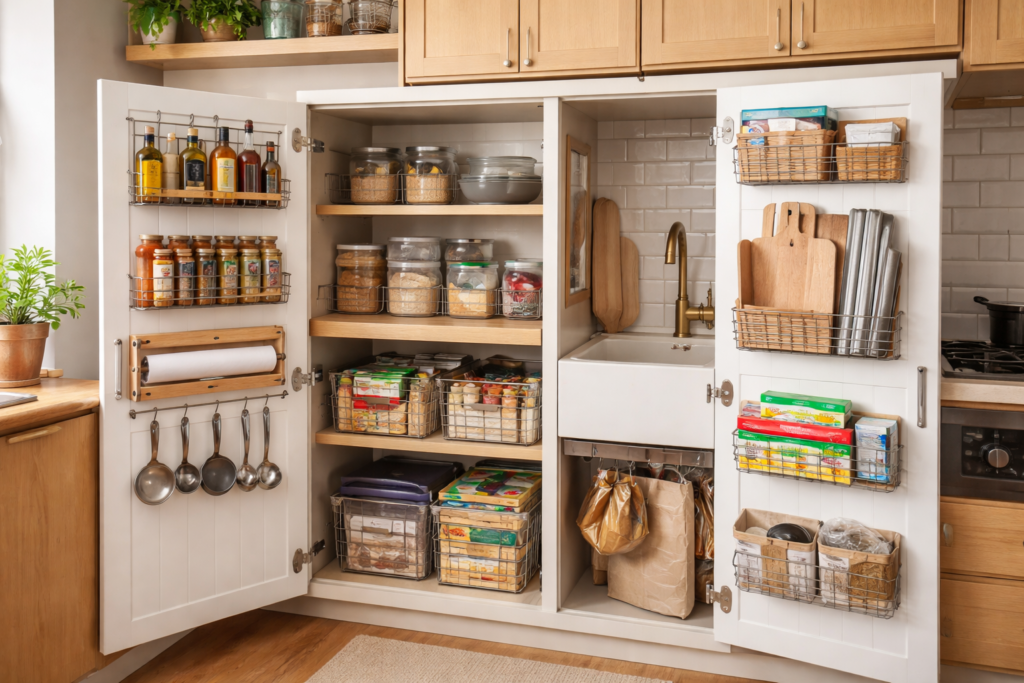
The insides of cabinet doors represent storage territory that is almost always wasted. Yet these surfaces offer prime real estate for lightweight items that need to be accessed frequently. Tapping into this space can significantly increase your kitchen’s capacity without consuming any additional shelf area .
The simplest cabinet door solution is an over-door organizer. These units hang from the top of the cabinet door and provide pockets for storing everything from cutting boards and baking sheets to cleaning supplies and food storage containers. Choose versions with mesh or clear pockets so you can see what’s inside at a glance .
For deeper cabinets, consider wire racks that attach to the inside of the door. These can hold spices, condiments, or small jars, keeping them visible and accessible while freeing up shelf space for larger items. The key is ensuring the door can still close securely—measure carefully before purchasing .
Adhesive hooks provide a no-drill option for lightweight items. Attach them to the inside of cabinet doors to hang measuring cups, oven mitts, kitchen towels, or small utensils. They’re inexpensive, removable, and require no tools, making them ideal for rental apartments where permanent modifications are prohibited .
For cabinet doors under the sink—often the most chaotic zone—door-mounted organizers can transform the space. Use them to hold cleaning supplies, sponges, and trash bags, keeping these items accessible while freeing up the cabinet interior for larger items .
3. Pull-Out Solutions: Bringing the Back Forward
Deep cabinets present a particular challenge in small kitchens: items at the back are difficult to access and easily forgotten. Pull-out solutions solve this problem by bringing the contents to you, eliminating the need to reach into dark recesses .
Pull-out shelves, also known as rollout trays, transform static cabinets into drawers. Installed on sliding tracks, they allow you to pull the entire shelf forward, giving you access to everything on it. This is perhaps the single most effective upgrade for base cabinets, where bending and reaching combine to create maximum frustration .
For existing cabinets that can’t be modified with full pull-out shelves, pull-out baskets offer a simpler solution. These wire baskets sit on the cabinet floor and slide forward on built-in rollers. They’re less expensive than full shelf systems and require no installation beyond placing them in the cabinet .
Pull-out spice racks are designed specifically for the narrow spaces beside refrigerators or between cabinets. These tall, narrow units slide out to reveal spice storage on multiple levels, making every jar visible and accessible. They utilize space that might otherwise go unused .
For corner cabinets, pull-out solutions become even more valuable. Magic corner systems bring even the deepest corner contents forward, eliminating the need to crawl into the cabinet to retrieve items. While more expensive than lazy susans, they provide superior access and can transform a useless corner into prime storage .
Under-sink pull-out organizers address the unique challenges of that space. Designed to fit around plumbing, these units slide forward to provide access to cleaning supplies that would otherwise be lost in the dark, pipe-obstructed depths .
4. The Magic of Lazy Susans and Turntables
Lazy susans—rotating trays that bring items to you—are classic kitchen organizers for good reason. They solve the fundamental problem of deep cabinets and corner spaces: items at the back are difficult to reach and easily forgotten .
In corner cabinets, a lazy susan transforms dead space into accessible storage. Choose a two-tier model to maximize vertical space, with shorter items on the top tier, taller on the bottom. The rotating action brings even the farthest corner items within easy reach .
In deep upper cabinets, lazy susans make items at the back accessible. Instead of reaching blindly into the depths, you simply spin the tray and bring what you need forward. This is particularly useful for spices, condiments, and small jars .
In refrigerators, lazy susans prevent the accumulation of forgotten items. Place one on a shelf to hold small containers, yogurt cups, or cheese packages. When you need something from the back, a spin brings it forward .
For pantries, lazy susans are essential for canned goods and jars. Group similar items together—all beans on one, all tomatoes on another—and spin to access whatever you need. This prevents the common problem of buying duplicates because you couldn’t see what you already had .
When choosing lazy susans, look for models with raised edges to prevent items from sliding off during rotation. Non-slip liners on the tray surface add another layer of security. For heavy items, ensure the rotating mechanism is sturdy enough to bear the weight .
5. Tension Rods: Simple Genius
Tension rods, those spring-loaded bars originally designed for curtains, have found a second life as kitchen organizers. Their beauty lies in their simplicity—they require no tools, no drilling, no permanent installation, yet they create instant storage solutions .
Use tension rods vertically inside cabinets to create dividers for baking sheets, cutting boards, and trays. Place a rod at each end of the cabinet, and slide your sheets between them. This keeps everything upright and accessible, preventing the chaotic slide that happens when these items are stacked horizontally .
Install tension rods horizontally under the sink to hang spray bottles from their triggers. This lifts them off the cabinet floor, freeing up space for other items and keeping the bottles accessible. The rods can be positioned at whatever height works for your bottles .
In deep cabinets, tension rods placed horizontally near the back can prevent items from sliding too far back and getting lost. They act as a barrier, keeping items within reach while still allowing you to use the full depth of the shelf .
For storing pot lids, tension rods placed vertically in a cabinet can create a lid rack. Slide lids between the rods, and they’ll stay upright and organized. Multiple rods can create compartments for different sizes .
Under the sink, tension rods can also hold cleaning cloths, dish towels, or scrub brushes. Simply drape items over the rod, and they’ll dry while staying accessible. This is particularly useful in kitchens with limited drawer space .
6. Over-the-Sink Innovations
The area above the sink is often overlooked, yet it represents valuable real estate that can be used for storage without interfering with sink function. Over-the-sink solutions take advantage of this space while keeping items within easy reach of where they’re needed .
An over-the-sink drying rack is perhaps the most practical solution. These racks sit directly over the sink, allowing washed dishes to drip dry without taking up counter space. When not in use, many models fold flat or roll up, disappearing until needed. Some include a utensil holder and a compartment for soap and sponges .
Over-the-sink cutting boards provide additional workspace in kitchens where counter space is limited. These boards sit securely over the sink, creating a stable surface for food preparation. When you’re done, simply remove the board and wash it in the sink below. Some models include a colander insert for washing vegetables .
A hanging pot rack installed over the sink can store frequently used pots and pans. While pot racks are typically installed over islands, positioning one over the sink makes sense in a small kitchen—any drips from washed pots fall into the sink rather than onto the floor or counter .
For renters who can’t install permanent fixtures, tension rods can create temporary storage. Install a tension rod horizontally above the sink and hang cleaning brushes, scrubbers, or lightweight utensils from S-hooks. This requires no drilling and can be removed without leaving marks .
7. Creative Drawer Organization
Drawers in small kitchens are precious commodities, but without organization, they become chaotic catch-alls where nothing can be found. Creative drawer organization transforms this chaos into order, allowing you to store significantly more in the same space .
Customizable bamboo dividers have become popular for good reason. They can be adjusted to fit any drawer size and reconfigured as your needs change. Use them to create compartments for utensils, measuring spoons, kitchen shears, and other tools. The compartments prevent items from sliding around and becoming tangled .
For deep drawers, consider tiered organizers that create two levels of storage. These are particularly useful for storing items like storage containers and their lids—place containers on the bottom, lids on the top, and you’ll never again dig through a pile searching for the matching lid .
Drawer inserts designed specifically for cutlery keep knives, forks, and spoons organized and easy to access. For small kitchens where drawer space is limited, consider combining cutlery with other utensils in a single drawer, using dividers to create distinct zones for different categories .
Peg-style dividers that slide into pre-drilled holes offer maximum flexibility. They allow you to create custom compartments of any size, adapting to your specific collection of items. This system works particularly well for drawers that hold a mix of items—baking tools, measuring cups, small gadgets—that don’t fit neatly into standard compartment sizes .
For deep drawers used for pots and pans, consider peg-style dividers that create vertical compartments. These allow you to store pans on their sides rather than stacked, protecting their surfaces and making each pan accessible without lifting a stack .
8. Magnetic Solutions for Metal Items
Magnets offer ingenious storage possibilities for metal items, utilizing wall space that would otherwise go unused while keeping frequently used tools accessible .
Magnetic knife strips are the classic magnetic solution. Mounted on the wall or backsplash, they keep knives safely accessible while freeing up drawer space. Unlike knife blocks, magnetic strips don’t trap bacteria and allow you to see all your knives at once. Choose strips with strong magnets that will securely hold even heavy knives .
Magnetic strips can also hold metal utensils. Mount a strip near the stove to keep spatulas, ladles, and spoons within easy reach while cooking. This is particularly useful in small kitchens where drawer space is limited and you want cooking tools immediately accessible .
For spice storage, magnetic spice tins attach directly to the refrigerator or any metal surface. These small tins with magnetic backs keep spices visible and accessible while freeing up cabinet space. Label the tops so you can identify spices at a glance .
Magnetic hooks can hold lightweight items like pot holders, oven mitts, or measuring cups. Attach them to the side of metal cabinets or the refrigerator for instant, accessible storage .
For a truly creative solution, consider a magnetic board mounted on the wall. Use it with magnetic containers to store small items like tea, spices, or baking supplies. The board becomes both storage and decor, especially if you choose an attractive container system .
9. Rolling Carts and Mobile Islands
In a small kitchen, fixed furniture consumes space that might be needed for different purposes at different times. Rolling carts and mobile islands offer the perfect solution—they provide storage and workspace when needed, then roll out of the way when they’re not .
A rolling kitchen cart can serve multiple functions. With a butcher block top, it provides additional counter space for food preparation. With shelves or drawers, it offers storage for pots, pans, or ingredients. With a towel bar on the side, it holds kitchen towels or hanging utensils. The key is choosing a cart that matches your specific needs and kitchen dimensions .
Look for carts with locking casters so they remain stable when in use. The wheels should be sturdy enough to roll smoothly over any transitions in your flooring. Consider the cart’s height—it should match your existing counter height if you plan to use it as additional workspace .
For extremely tight spaces, consider a narrow rolling cart designed to fit between cabinets or against a wall. These slim units can hold spices, oils, and frequently used items while occupying minimal floor space. Some are designed to fit in the gap between your refrigerator and wall—space that is otherwise wasted .
A rolling kitchen island provides more substantial storage and workspace. Look for units with open shelving for frequently used items, drawers for utensils, and cabinets for larger pots. Some islands include a drop-leaf extension that provides additional surface when needed and folds down when not in use .
10. Under-Cabinet Solutions
The space under upper cabinets is often used only for countertop appliances, but creative solutions can multiply its utility .
Under-cabinet mounted paper towel holders keep paper towels accessible without consuming counter space. Choose models that mount with adhesive for renters or screws for permanent installation. Some include a rail for hanging utensils or a shelf for small items .
Under-cabinet lighting serves both function and ambiance, but the space above the lights can also be used. Install a narrow shelf just above the light strip to hold small items like salt and pepper, frequently used spices, or decorative elements .
Under-cabinet mounted spice racks keep spices visible and accessible while cooking. These racks attach to the underside of upper cabinets, placing spices at eye level and within easy reach. Look for models with rails that hold jars securely .
Under-cabinet mounted knife racks provide another option for knife storage. These horizontal racks keep knives accessible while freeing up drawer and counter space. Choose magnetic models or slotted racks depending on your preference .
For wine lovers, under-cabinet mounted wine glass racks keep stemware accessible and displayed. These racks hang glasses upside down, preventing dust accumulation while keeping them within easy reach .
11. Corner Solutions: Wasted Space No More
Corner cabinets and corner counter spaces are notoriously difficult to use, but creative solutions can transform them into valuable storage .
For corner cabinets, a lazy susan is the classic solution, but more sophisticated options exist. Magic corner pull-out systems bring even the deepest corner contents forward, eliminating the need to reach into the cabinet. These systems are more expensive than lazy susans but provide superior access .
For open corner shelving, consider diagonal shelves that follow the corner angle. These custom shelves can be built to fit your specific space, creating storage for items that would otherwise be difficult to place .
For corner counter space, consider a corner carousel that sits on the counter and provides rotating storage for frequently used items like oils, spices, and condiments. This keeps them accessible while using space that might otherwise go unused .
For the corner between counter and wall, consider a narrow rolling cart designed to fit in tight spaces. These slim units can hold cleaning supplies, recycling, or pantry items, utilizing space that is often wasted .
12. Creative Use of Unconventional Spaces
Beyond the obvious storage areas, small kitchens often contain unconventional spaces that can be pressed into service with a little creativity .
The space above cabinets, if you have upper cabinets, often goes unused. While reaching this high space is inconvenient, it’s perfect for items you use rarely—special occasion serveware, seasonal decorations, or bulk supplies. Baskets or bins corral items and make them easier to lower when needed .
The side of cabinets provides vertical surface for adhesive hooks or small racks. Hang pot holders, kitchen towels, or measuring cups here—items you need frequently but that don’t require deep storage. This keeps them accessible without consuming drawer or cabinet space .
The space between appliances—the gap between refrigerator and wall, or between stove and cabinet—can accommodate a slim rolling cart. These narrow units are designed specifically for such gaps and can hold spices, oils, or cleaning supplies .
The back of the door—whether pantry door, kitchen door, or even bathroom door if it’s nearby—can hold an over-door organizer. Use it for pantry items, cleaning supplies, or kitchen tools. These organizers are inexpensive and require no installation .
The inside of a pantry door, if you have a pantry, offers prime storage for lightweight items. Spices, condiments, and small packages can all live here, visible and accessible. Adhesive organizers or over-door racks make this space usable without permanent modifications .
| Storage Solution | Best For | Installation Required | Approximate Cost | Space Utilized |
|---|---|---|---|---|
| Vertical Shelving | Dishes, pantry items, appliances | Drilling | $$ | Wall space |
| Cabinet Door Organizers | Spices, cutting boards, cleaning supplies | Adhesive or over-door | $ | Inside cabinet doors |
| Pull-Out Shelves | Base cabinets, deep cabinets | Moderate | $$$ | Cabinet interiors |
| Lazy Susans | Corner cabinets, deep shelves | None | $ | Corner and deep spaces |
| Tension Rods | Under-sink, baking sheets | None | $ | Vertical and horizontal dividers |
| Over-Sink Racks | Drying dishes, cutting boards | None | $ | Air space above sink |
| Drawer Dividers | Utensils, tools, cutlery | None | $ | Drawer interiors |
| Magnetic Strips | Knives, metal utensils | Adhesive or drilling | $ | Wall or backsplash |
| Rolling Carts | Extra storage, additional workspace | Assembly only | $$ | Floor space |
| Under-Cabinet Solutions | Spices, paper towels, lighting | Adhesive or drilling | $ | Under-cabinet space |
| Corner Systems | Corner cabinets | Moderate | $$$ | Corner cabinets |
| Unconventional Spaces | Rarely used items, cleaning supplies | Varies | Varies | Over-cabinet, between appliances |
The Philosophy of Small Kitchen Storage
Living with a small kitchen teaches you a different relationship with your possessions. You learn that you don’t need as much as you think you do. You learn that every item must earn its place. You learn that accessibility matters more than capacity—a cabinet full of things you can’t reach is useless .
This philosophy extends beyond storage to how you think about your kitchen overall. A small kitchen forces intentionality. You can’t accumulate randomly because there’s no space for random accumulation. Every purchase must be considered: Do I really need this? Where will it go? What will I give up to make room for it? .
This intentionality is liberating rather than limiting. It frees you from the burden of excess possessions. It ensures that everything in your kitchen serves a purpose and brings you joy. It makes cooking more pleasurable because you’re working with tools and ingredients you’ve chosen deliberately, not struggling through clutter .
Implementing Creative Storage Solutions
The key to successful small kitchen storage is not implementing every idea but choosing the ones that work for your specific space and needs. Start by assessing your kitchen honestly. Where are the pain points? Which areas frustrate you most? What would make the biggest difference in your daily cooking experience ?
Then prioritize. Choose one or two solutions that address your biggest frustrations and implement them fully. Live with the changes for a while before moving on to the next project. This gradual approach prevents overwhelm and allows you to refine your solutions based on how they actually work in practice .
Remember that storage solutions should serve you, not the other way around. If a system is too complicated to maintain, if it requires constant adjustment, if it makes items harder to access rather than easier, it’s not working. Be willing to experiment and adjust until you find what works for your specific habits and needs .
Conclusion : Creative Storage Solutions for Small Kitchens
A small kitchen need not be a frustrating kitchen. With creativity and intentionality, even the tiniest space can become a model of efficiency and a pleasure to use. The solutions presented here—from vertical storage and cabinet door organizers to pull-out systems and rolling carts—provide a toolkit for transforming your kitchen’s storage capacity without adding square footage.
The most creative solutions often come from looking at familiar spaces with fresh eyes. That gap between refrigerator and wall could hold a slim cart. The inside of that cabinet door could store spices. The space above the sink could become a drying rack. Every inch of your kitchen has potential; it’s simply a matter of seeing it .
Start small. Address one frustration at a time. Implement solutions that work for your specific space and your specific needs. Gradually, your kitchen will transform from a source of frustration into a space of possibility—a place where everything has a home, where cooking is a pleasure, where creativity flourishes within constraints. That is the promise of creative storage: not just more space, but a better relationship with the space you have.