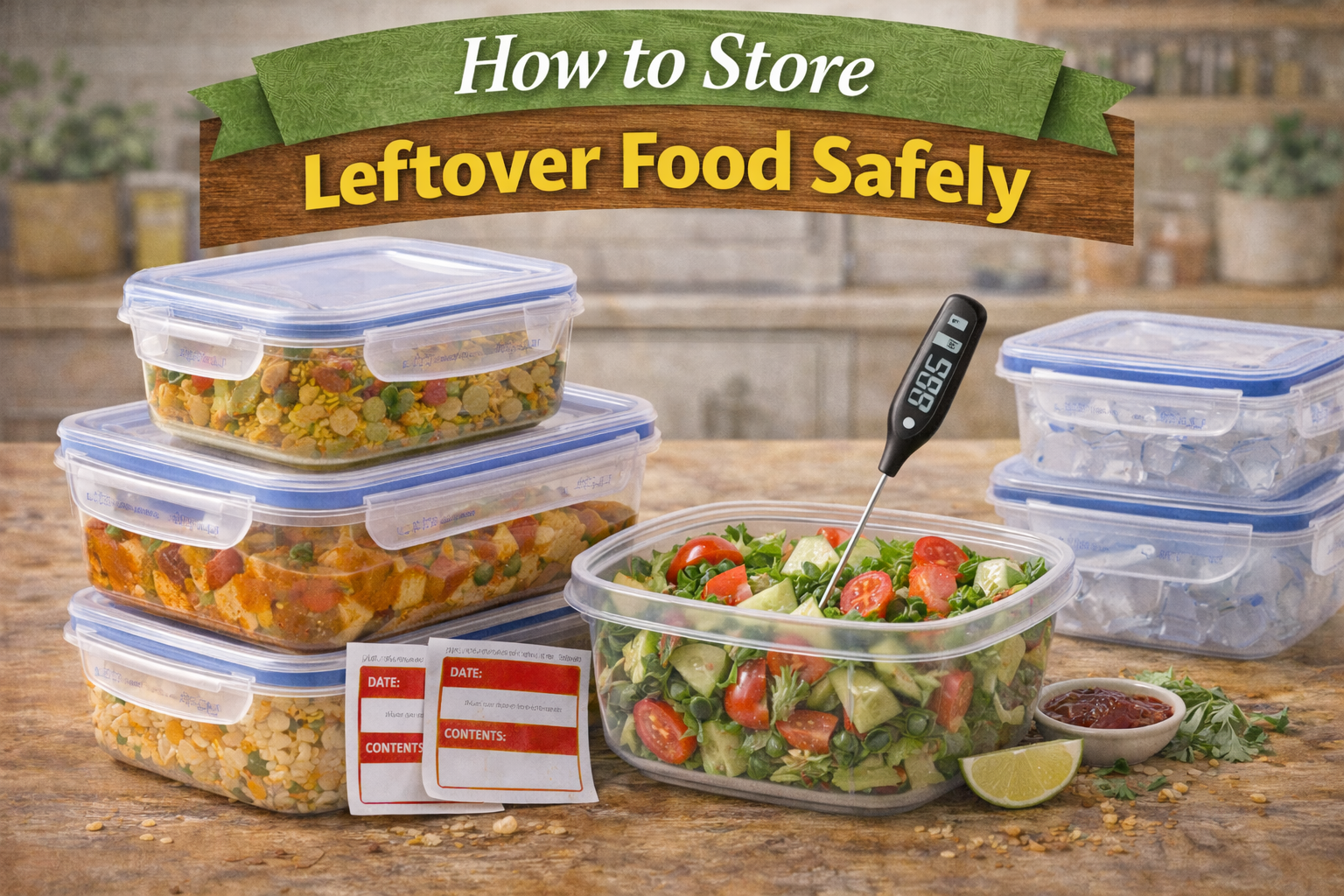
How to Store Leftover Food Safely : There is a quiet satisfaction that comes from opening the refrigerator the day after a big meal and seeing a neat row of containers filled with delicious leftovers. It is a small victory against food waste, a testament to your resourcefulness, and a promise of easy meals in the days ahead. Yet beneath this satisfying sight lurks a question that every home cook should consider: are those leftovers safe to eat? The line between a convenient meal and a trip to the doctor can be thinner than most people realize.
Food safety is not just about avoiding spoiled food that looks or smells bad. The most dangerous foodborne pathogens are often invisible, tasteless, and odorless. They can multiply rapidly in the “danger zone” temperature range, turning a perfectly good meal into a health hazard within hours. Understanding how to properly cool, store, and reheat leftovers is an essential life skill that protects you and your family from food poisoning. This comprehensive guide will walk you through every step of the process, from the moment you finish cooking to the moment you reheat that final portion. You will learn the science behind safe storage, the best practices for different types of food, and how to recognize when leftovers have outlived their welcome. Let’s ensure that your leftovers remain a blessing, not a risk.
- Read More : How to Prevent Ants in Kitchen Naturally,
- How to Maintain Wooden Kitchen Cabinets Properly,
- How to Remove Oil Stains from Kitchen Tiles Easily
Part 1: Understanding the Danger Zone
Before diving into specific techniques, it is crucial to understand why food spoils and how bacteria grow.
- The Temperature Danger Zone: Bacteria that cause foodborne illness grow most rapidly between 40°F (4°C) and 140°F (60°C). This range is known as the “danger zone.” Within this temperature range, bacterial populations can double in as little as 20 minutes .
- The Two-Hour Rule: Perishable foods should never be left at room temperature for more than two hours. If the ambient temperature is above 90°F (32°C), as on a hot summer day, that window shrinks to just one hour .
- Why Rapid Cooling Matters: When you put a large pot of hot food directly into the refrigerator, the center of the pot can remain in the danger zone for hours, allowing bacteria to multiply. The goal is to cool food from 140°F to 40°F as quickly as possible, ideally within two hours .
- Common Pathogens: Bacteria like Salmonella, E. coli, and Staphylococcus aureus are common culprits in food poisoning. They can be present in food that looks, smells, and tastes perfectly normal .
Part 2: The Golden Rules of Leftover Storage
These fundamental principles apply to almost all leftover foods and form the foundation of safe storage practices.
- Rule 1: Refrigerate Promptly: Do not let cooked food sit out for more than two hours. Set a timer if you need to. This is the single most important rule .
- Rule 2: Cool Quickly Before Refrigerating (But Not Too Long): While you should not put a large, steaming pot directly into the fridge (it will raise the internal temperature and endanger other foods), you also should not leave it out for hours. The goal is to cool it to room temperature within two hours, then refrigerate .
- Rule 3: Divide and Conquer: Large quantities of food cool slowly. Divide big pots of soup, curry, or stew into smaller, shallow containers. This increases the surface area and allows the food to cool much faster .
- Rule 4: Use Shallow Containers: Store leftovers in containers that are two inches deep or less. This ensures rapid, even cooling .
- Rule 5: Cover Foods Properly: Cover leftovers tightly with lids, plastic wrap, or aluminum foil. This prevents them from absorbing odors from other foods, prevents cross-contamination, and retains moisture .
- Rule 6: Label and Date: Get in the habit of labeling your containers with the contents and the date they were stored. A roll of masking tape and a marker are inexpensive insurance against mystery containers and forgotten leftovers .
- Rule 7: Keep Your Refrigerator at the Right Temperature: Ensure your refrigerator is set to 40°F (4°C) or below. Use an appliance thermometer to verify, as built-in dials are not always accurate .
- Rule 8: Keep Your Freezer at 0°F: For long-term storage, your freezer should be at 0°F (-18°C) or below. This stops bacterial growth completely .
Read More : 12 Quick South Indian Breakfast Recipes
10 Nutritious Breakfast Ideas for a Healthy Lifestyle
10 Quick Paneer Breakfast Recipes for Protein Boost
Part 3: Best Practices for Specific Foods
Different types of food have different storage needs and shelf lives. Here is a detailed guide for common leftovers.
Rice and Grains
Cooked rice and grains are a common source of food poisoning because they can contain Bacillus cereus, a bacteria that produces heat-resistant toxins.
- Cool Quickly: Spread cooked rice or grains on a baking sheet to cool rapidly before transferring to a container .
- Storage: Store in an airtight container in the refrigerator for up to 3-4 days .
- Reheating: Ensure rice and grains are steaming hot throughout when reheated. Do not reheat rice more than once .
Meat, Poultry, and Fish
These protein-rich foods are particularly susceptible to bacterial growth.
- Storage: Remove meat from the bone and store in shallow, airtight containers. Refrigerate for 3-4 days .
- Freezing: Most cooked meats freeze well for 2-6 months. Wrap tightly in freezer-safe wrap or containers to prevent freezer burn .
- Reheating: Reheat until the internal temperature reaches 165°F (74°C). Gravy and sauces should be brought to a rolling boil .
Soups, Stews, and Curries
These liquid-based dishes are easy to store but require attention to cooling.
- Cool Quickly: Divide large pots into smaller, shallow containers. You can also place the pot in an ice water bath and stir to accelerate cooling .
- Storage: Refrigerate for 3-4 days. Freeze for 2-3 months .
- Reheating: Reheat on the stovetop until bubbling hot, or in the microwave, stirring halfway through to ensure even heating .
Vegetable Dishes
Cooked vegetables have varying shelf lives depending on their preparation.
- Storage: Store in airtight containers. Most cooked vegetables will keep for 3-4 days .
- Leafy Greens: Cooked spinach, kale, and other greens are best eaten within 1-2 days as they deteriorate quickly .
- Reheating: Vegetables can be reheated in the microwave, on the stovetop, or in the oven. They may lose some texture but are still safe .
Dairy-Based Dishes
Dishes containing milk, cream, or yogurt require extra care.
- Storage: Refrigerate promptly. Dishes with dairy are best eaten within 1-2 days .
- Freezing: Cream-based sauces may separate upon thawing. If you must freeze, reheat gently and whisk to recombine .
- Reheating: Reheat gently over low heat to prevent curdling. Do not boil vigorously .
Cooked Pasta and Noodles
Pasta dishes can be stored successfully but may absorb sauce and become softer over time.
- Storage: Store in airtight containers for 3-5 days. If possible, store pasta and sauce separately to prevent sogginess .
- Reheating: Reheat on the stovetop with a splash of water or broth to restore moisture, or in the microwave .
Part 4: The Art of Cooling Before Refrigerating
This step is often misunderstood and mishandled. Here is how to do it right.
- The Two-Hour Window: You have two hours from the time food finishes cooking to get it into the refrigerator. This includes the time it sits on the table during the meal .
- Rapid Cooling Methods:
- Shallow Containers: Transfer food to shallow containers (2 inches deep or less) immediately after serving .
- Ice Bath: For large quantities of soup or stock, place the pot in a sink filled with ice water. Stir frequently to accelerate cooling .
- Divide into Smaller Portions: Split a large pot of curry into several smaller containers before refrigerating .
- Leave the Lid Slightly Ajar: When placing warm food in the refrigerator, leave the lid slightly ajar for the first hour to allow heat to escape, then seal tightly .
- What Not to Do: Do not leave food on the counter to cool for hours. Do not put a large, steaming pot directly into the refrigerator .
Part 5: Choosing the Right Containers
The container you choose matters for both safety and quality.
- Glass Containers: These are ideal. They are non-porous, do not absorb odors or stains, are microwave-safe, and do not leach chemicals. Look for tempered glass with tight-fitting lids .
- BPA-Free Plastic Containers: These are lightweight and unbreakable. Ensure they are labeled as food-safe and BPA-free. Avoid using old, scratched plastic containers, as bacteria can hide in scratches .
- Stainless Steel: Excellent for storage but not microwave-safe. Good for packing lunches but not for reheating .
- Airtight Lids: A tight seal is essential to prevent contamination and maintain quality .
- What to Avoid: Do not store food in opened cans. Transfer canned food to a container after opening. Avoid using containers that are not food-grade, such as old margarine tubs or takeout containers not designed for reuse .
Part 6: How Long Do Leftovers Last?
Knowing the shelf life of different foods helps you plan meals and avoid waste.
Refrigerator Storage Times (at 40°F or below):
- Cooked meat, poultry, and fish: 3-4 days
- Soups, stews, and curries: 3-4 days
- Cooked vegetables: 3-4 days
- Cooked rice and grains: 3-4 days
- Cooked pasta: 3-5 days
- Egg and dairy dishes: 2-3 days
- Gravy and broth: 1-2 days
- Casseroles: 3-4 days
Freezer Storage Times (at 0°F or below):
- Cooked meat and poultry: 2-6 months
- Soups and stews: 2-3 months
- Cooked vegetable dishes: 2-3 months (quality may decline)
- Casseroles: 2-3 months
- Cooked rice and grains: 1-2 months
Note: These are guidelines for quality, not just safety. Frozen food remains safe indefinitely, but quality deteriorates over time .
Part 7: The Freezer: Your Leftover Ally
The freezer is an excellent tool for extending the life of leftovers, but it requires proper technique.
- Cool Before Freezing: Food should be completely chilled in the refrigerator before transferring to the freezer .
- Portion for Convenience: Freeze in meal-sized portions. This allows you to thaw only what you need .
- Use Freezer-Safe Containers: Not all containers are freezer-safe. Glass can crack if food expands, so leave headspace. Use containers designed for freezing .
- Remove Air: For long-term freezer storage, remove as much air as possible to prevent freezer burn. Vacuum sealers are ideal, but you can also press plastic wrap directly onto the surface of the food before sealing the container .
- Label Everything: Frozen food all looks alike. Label each container with the contents and date .
- Thaw Safely: The safest way to thaw frozen leftovers is in the refrigerator overnight. You can also thaw in cold water (in a leak-proof bag) or in the microwave if you will reheat immediately . Never thaw at room temperature .
Part 8: Reheating Leftovers Safely
Proper reheating is the final critical step in ensuring food safety.
- Heat Thoroughly: Leftovers should be reheated to an internal temperature of 165°F (74°C). Use a food thermometer to be certain .
- Sauces and Gravies: Bring these to a rolling boil .
- Stirring: When microwaving, stir halfway through to eliminate cold spots where bacteria can survive .
- Reheat Only Once: Only reheat the amount you will eat. Repeatedly reheating and cooling food increases risk and degrades quality .
- Use Appropriate Methods: Reheat soups and curries on the stovetop. Reheat solid foods like casseroles in the oven or microwave. Reheat rice and grains thoroughly, ensuring they are steaming hot .
- When in Doubt, Throw It Out: If leftovers have been in the refrigerator for more than 4 days, or if you have any doubt about their safety, discard them .
Part 9: Signs That Leftovers Have Spoiled
While pathogens cannot always be detected by senses, spoilage organisms often produce noticeable changes.
- Smell: Any off, sour, or unpleasant odor is a clear sign that food has spoiled .
- Appearance: Mold, discoloration, or a slimy texture indicate spoilage .
- Texture: If food has become unusually mushy, watery, or separated in an unappetizing way, it is best to discard it .
- Taste: If food looks and smells normal but tastes off, spit it out and discard the rest .
- Trust Your Instincts: If something seems wrong, do not take the risk. Food poisoning is not worth a few dollars worth of leftovers .
Part 10: Common Mistakes to Avoid
Even experienced cooks can make these errors. Be aware of them.
- Putting Hot Food Directly in the Fridge: This raises the internal temperature of the refrigerator and endangers other foods .
- Leaving Food Out Too Long: The two-hour rule is non-negotiable .
- Overpacking the Refrigerator: A crowded refrigerator cannot circulate cold air properly, leading to uneven temperatures .
- Storing Food in Opened Cans: Transfer canned food to a container after opening .
- Tasting Food to See If It Is Still Good: If you are unsure, discard it. Do not taste potentially spoiled food .
- Reheating Food More Than Once: Only reheat the portion you plan to eat .
- Using Worn-Out Containers: Scratched plastic and cracked containers can harbor bacteria .
- Ignoring Date Labels: If you do not know when something was stored, it is safer to throw it away .
Part 11: Special Considerations for Festive and Bulk Cooking
During holidays and celebrations, we often cook in larger quantities. Extra care is needed.
- Plan for Leftovers: Have plenty of shallow containers ready before you start cooking .
- Serve Smartly: Put out small amounts of food at a time and replenish from the kitchen. This prevents the entire batch from sitting out for hours .
- Clear the Table Promptly: As soon as the meal is over, pack up leftovers. Do not leave food sitting out while you socialize .
- The Buffet Danger: If you are serving a buffet, keep hot foods hot (above 140°F) with chafing dishes or slow cookers, and keep cold foods cold (below 40°F) by nesting bowls in ice .
- Gift Leftovers Safely: If you send guests home with leftovers, ensure they are packed in clean containers and remind them to refrigerate promptly .
Conclusion: ( How to Store Leftover Food Safely )
Storing leftover food safely is not just a set of rules; it is a mindset. It is about respecting the food you have prepared, valuing the resources that went into it, and protecting the health of those you feed. By understanding the science of bacterial growth, following the golden rules of cooling and storage, and using your senses and judgment, you can transform leftovers from a potential hazard into a reliable resource.
The extra few minutes it takes to divide a pot of curry into shallow containers, to label a container before freezing, or to check the temperature of your refrigerator are small investments that pay dividends in safety, quality, and peace of mind. Leftovers, handled correctly, are a gift—a home-cooked meal waiting to be enjoyed on a busy day when you have no time to cook. Treat them with care, and they will serve you well. Happy cooking, and safe storing.
3 thoughts on “How to Store Leftover Food Safely”